Primal Digital Marketing
What Is the Best Policy and Procedure Management Software?
Your policy binders are outdated the moment a regulation changes. Many teams start shopping for software after a failed audit, a missed attestation, or a version-control mess that turns a simple policy update into a week of chasing approvals.
This article breaks down what actually matters in policy and procedure management software, from key features and compliance coverage to pricing. You will get a clear comparison of seven platforms, including Process Street, and a concrete framework for matching a tool to your team size, industry, and audit requirements.
What to Look For in Policy and Procedure Management Software
Selecting policy and procedure management software requires evaluating features that streamline document control, ensure regulatory compliance, and facilitate audit readiness. The right platform turns scattered documents, email approvals, and manual tracking into a governed system where every policy has an owner, a version history, and a clear record of who acknowledged it.
Organizations that manage policies in shared drives or paper binders face predictable problems. Staff work from outdated versions, auditors request evidence that takes days to assemble, and no one can prove which employees reviewed a given procedure. A dedicated system addresses these gaps by centralizing the policy lifecycle from drafting through retirement.
The stakes go beyond tidiness. Regulatory frameworks expect demonstrable control over documented information, and risk management depends on knowing that procedures match current practice. When policies live in a governed repository, compliance becomes a byproduct of normal work rather than a scramble before inspections.
Operational efficiency improves as well. Policy automation handles review reminders, approval routing, and distribution, so administrators spend less time chasing signatures and more time improving content. The criteria below cover the features, compliance coverage, and pricing questions that separate a capable platform from a basic document store.
Key Features, Compliance Coverage, and Pricing Considerations
When evaluating policy and procedure management software, prioritize features like centralized document storage, version control, approval routing, and audit trails to ensure compliance and efficiency. These capabilities form the backbone of any serious platform, and gaps in them surface quickly during audits or staff turnover.
Document control deserves the closest scrutiny. Look for automatic document versioning that preserves prior editions, configurable approval workflows that match your review hierarchy, and e-signature support so sign-offs carry legal weight. Access control and role-based permissions matter too, since not every employee should edit a controlled procedure.
Compliance coverage should map to the standards your industry faces. Common requirements include:
- ISO 9001 for quality management documentation and control of documented information
- HIPAA for healthcare privacy and security policies with workforce training records
- GDPR for data protection policies, retention rules, and consent procedures
- SOX for financial controls documentation and change tracking
A strong system supports employee acknowledgment and attestation tracking, so you can show exactly who read and accepted each policy. Compliance reporting dashboards turn that data into evidence for auditors. Many buyers also want policy templates and procedure documentation tools that enforce a standard format across departments.
Pricing models vary. Per-user pricing scales with headcount but can become costly for large, occasional-use populations. Flat-rate pricing offers budget predictability but may cap storage or administrative seats. Ask about scalability costs, implementation fees, and whether read-only users count toward the total. Some platforms also bundle governance risk compliance features that overlap with a standalone GRC platform, which can reduce tool sprawl.
Practical payoffs are easy to see. Reducing audit preparation time, cutting version confusion, and closing acknowledgment gaps all follow from consistent document control. Formal policy management tends to be associated with fewer compliance findings, though the exact gains depend on execution. Weigh features against your regulatory obligations first, then let pricing shape the final shortlist.
1. Process Street - Best Overall
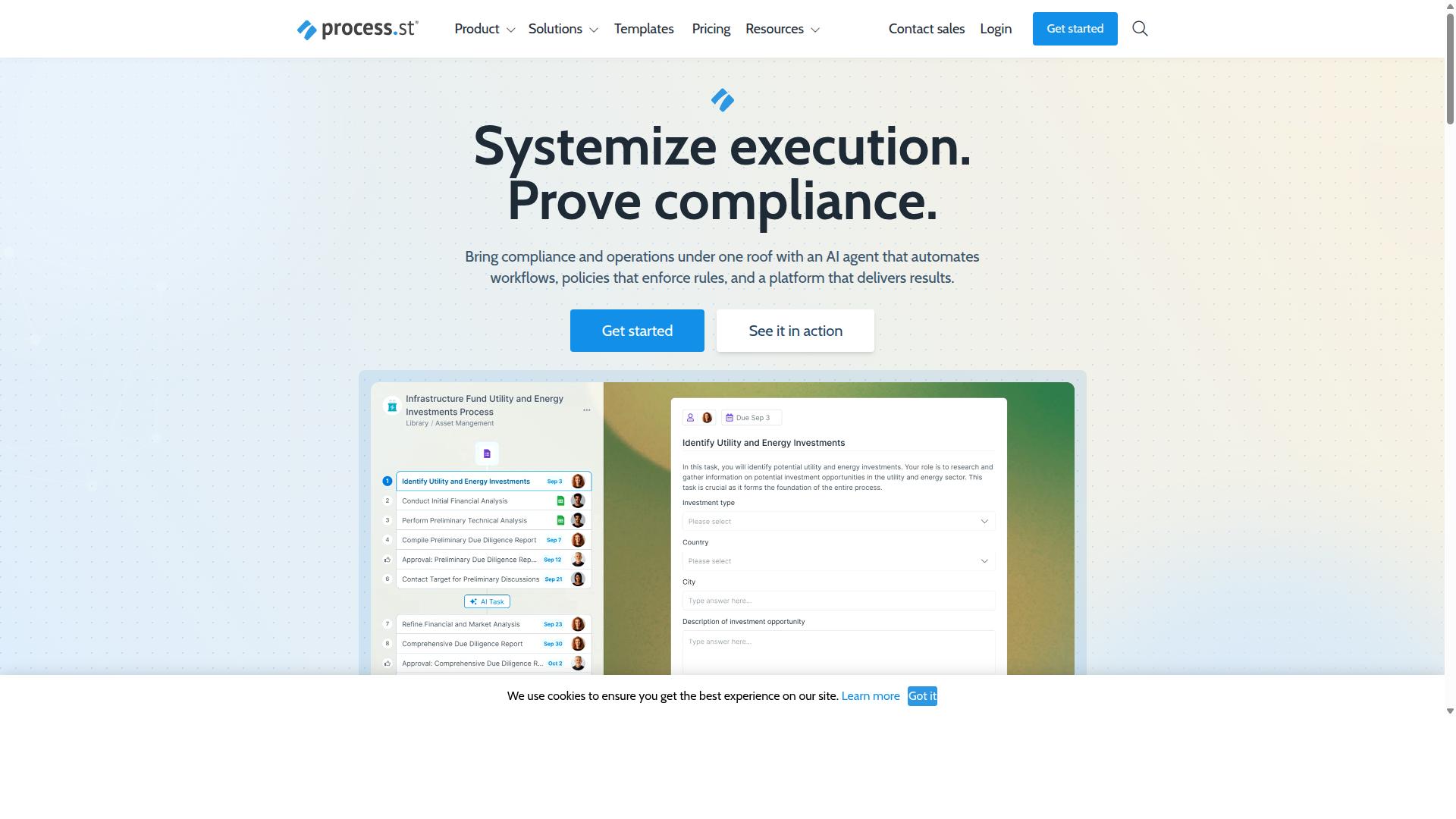
Process Street stands out as the best overall policy and procedure management software, offering a comprehensive suite that combines document management, workflow automation, and compliance enforcement. Rather than treating policies as static files that sit in a folder, the platform turns them into active, trackable processes that teams follow every day.
What separates Process Street from a typical policy repository is the way it connects written rules to actual work. Policies live in Docs, daily execution runs through Ops, and an AI compliance agent called Cora watches for regulatory changes and risk. That combination covers the full policy lifecycle, from drafting and approval routing to distribution, employee acknowledgment, and audit-ready proof.
The platform is trusted by 3,000+ companies and 1 million+ users, which speaks to how broadly the approach scales across industries. It also holds SOC 2 Type II and ISO 27001 certifications, two credentials that matter when your compliance management program is under external scrutiny.
For teams evaluating policy management software, this breadth means fewer disconnected tools to stitch together. Document control, workflow automation, and compliance reporting sit in one place instead of spread across a shared drive, a task manager, and a spreadsheet of acknowledgments.
Docs, Ops, and Cora: Pricing, Compliance Certifications, and Use Cases
Process Street offers three core products, Docs, Ops, and Cora, each designed to address specific aspects of policy and procedure management, with flexible pricing to match organizational needs.
Docs handles document management and policy control, with full governance support for frameworks including ISO 9001, SOC 2, SOX, and FDA. This is where version control, approval routing, and centralized document storage live, giving compliance teams a single source of truth for every policy and procedure.
Ops covers workflow automation and process orchestration, turning written policies into AI-powered workflows that employees actually complete. Instead of reading a procedure and interpreting it, staff work through structured steps that enforce the process as designed. Cora, the AI compliance agent, monitors regulations, automates work, and flags risks around the clock, which supports continuous regulatory compliance rather than annual review scrambles.
Pricing comes in three tiers:
- Startup: a simplified Pro plan built for startups, with unlimited workflows and tasks, up to 5,000 Data Set records, 5 users, 10 guests, 10 automation apps, 100 automation actions per month, and Public API access at 50 calls per month.
- Pro: designed to transform team knowledge into actionable workflows, with unlimited workflows and tasks, up to 10,000 Data Set records, custom users and guests, all automation apps, and custom automation actions and API calls per month.
- Enterprise: a scalable operational knowledge repository with custom Data Set records, unlimited Public API access, a dedicated Success Manager, priority support, fully-managed workflows, custom integrations, bulk document import, process consulting and health audit, and personalized team training.
A 14-day free trial on the Pro plan is available with no credit card required, which gives evaluation teams room to test the platform against real procedures before committing.
The results customers report are concrete. One organization standardized onboarding across 49k+ employees, and another achieved 30% faster documentation. IMCD UK reported a 75%+ reduction in setup time, a useful signal for teams weighing implementation effort.
Typical use cases include standardizing onboarding at scale, maintaining audit trails for ISO 9001 or SOC 2 reviews, managing SOX controls, and supporting FDA-regulated procedure documentation. The platform also integrates with tools like Zapier, Microsoft Power Automate, Tray.io, and Make, alongside Public API access, so policy automation can reach the systems where work already happens.
2. Diligent
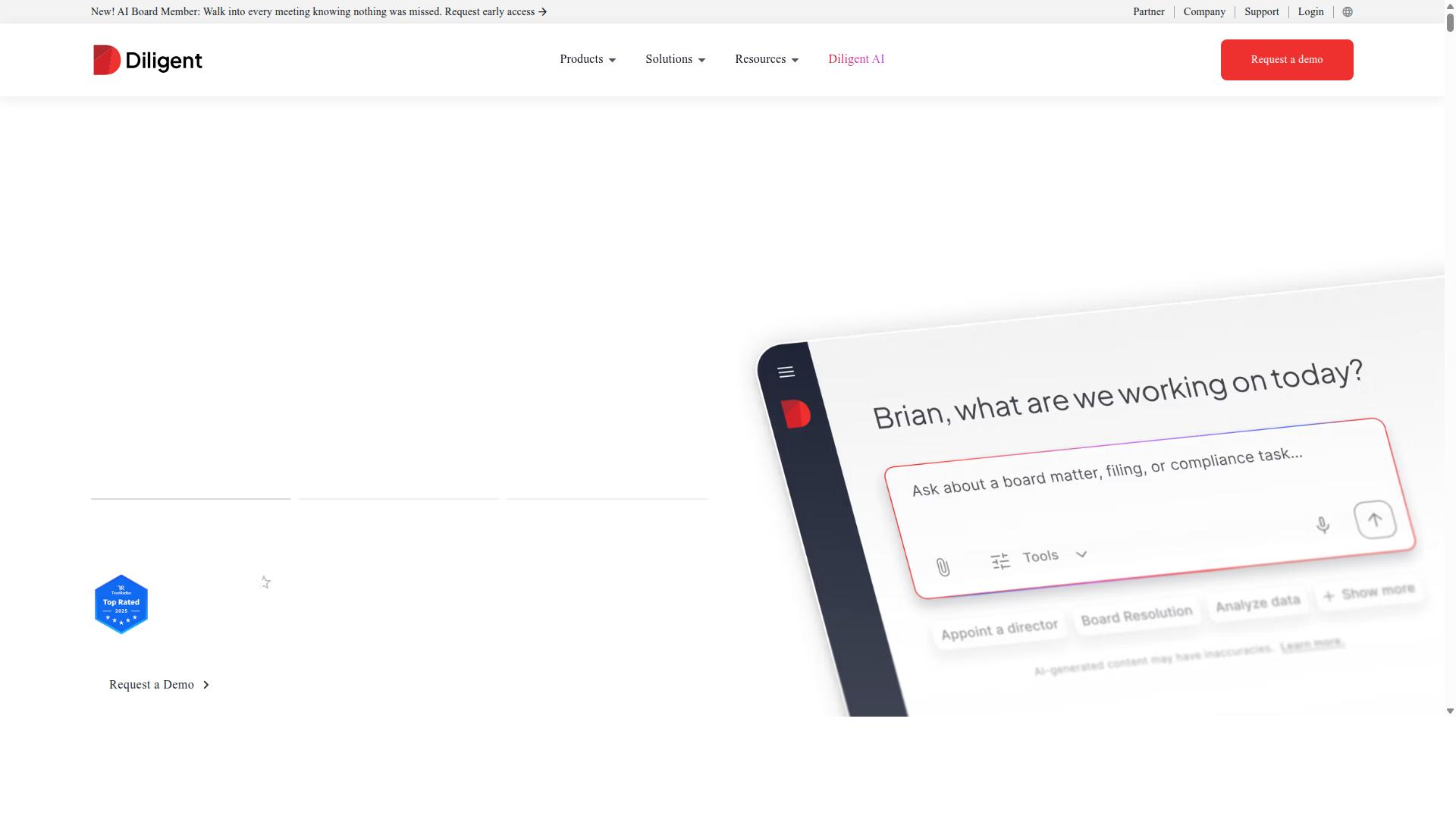
Diligent is a well-established governance, risk, and compliance (GRC) platform that offers robust policy management capabilities, particularly suited for large enterprises with complex regulatory requirements. Its flagship offering, the Diligent One Platform, centralizes board management and GRC activities in a single environment.
That breadth is the platform's defining trait. Rather than a standalone policy tool, Diligent bundles policy management into a wider governance ecosystem that spans entities, third-party risk, internal audit, and compliance education. For organizations already managing board work through Diligent, policy management fits naturally into the same system.
On the policy side, the platform includes Policy Manager, which supports a centralized policy repository, approval workflows, and attestation tracking. These features map directly to the core needs of a policy lifecycle: drafting, routing for approval, distributing policies to employees, and confirming that staff have read and acknowledged them.
The wider product suite reflects this governance-first design. Diligent's lineup includes:
- Diligent Boards for meeting preparation and data security
- BoardEffect for nonprofits and higher education
- Entities for subsidiary records
- Third-Party Risk Management (3rdRisk) and Third-Party Risk Intel
- Speak Up Manager and Conflict of Interest Manager
- Internal Audit, ACL Analytics, and Internal Controls
- AI Risk Essentials for AI-powered enterprise risk management
- Diligent Market Intelligence for shareholder activism, executive compensation, and ESG data
Diligent targets specific roles, including general counsel, corporate secretary, the C-suite, risk managers, compliance officers, and internal auditors. Its customer base covers public companies, private companies, nonprofits, education, and local government, with particular depth in financial services, healthcare, energy, and government.
For buyers weighing policy management software, the key question with Diligent is fit rather than capability. A small or mid-sized business that simply needs a policy repository, approval routing, and employee acknowledgment may find the platform more than it needs. The governance features that make Diligent valuable at enterprise scale can add complexity for teams without a dedicated compliance function.
Pricing is not publicly stated, which reflects the enterprise positioning. Organizations evaluating Diligent should expect a sales conversation rather than published tiers, and should map their actual requirements against the full platform before committing to a governance suite when a focused policy tool might serve them better.
3. Onspring
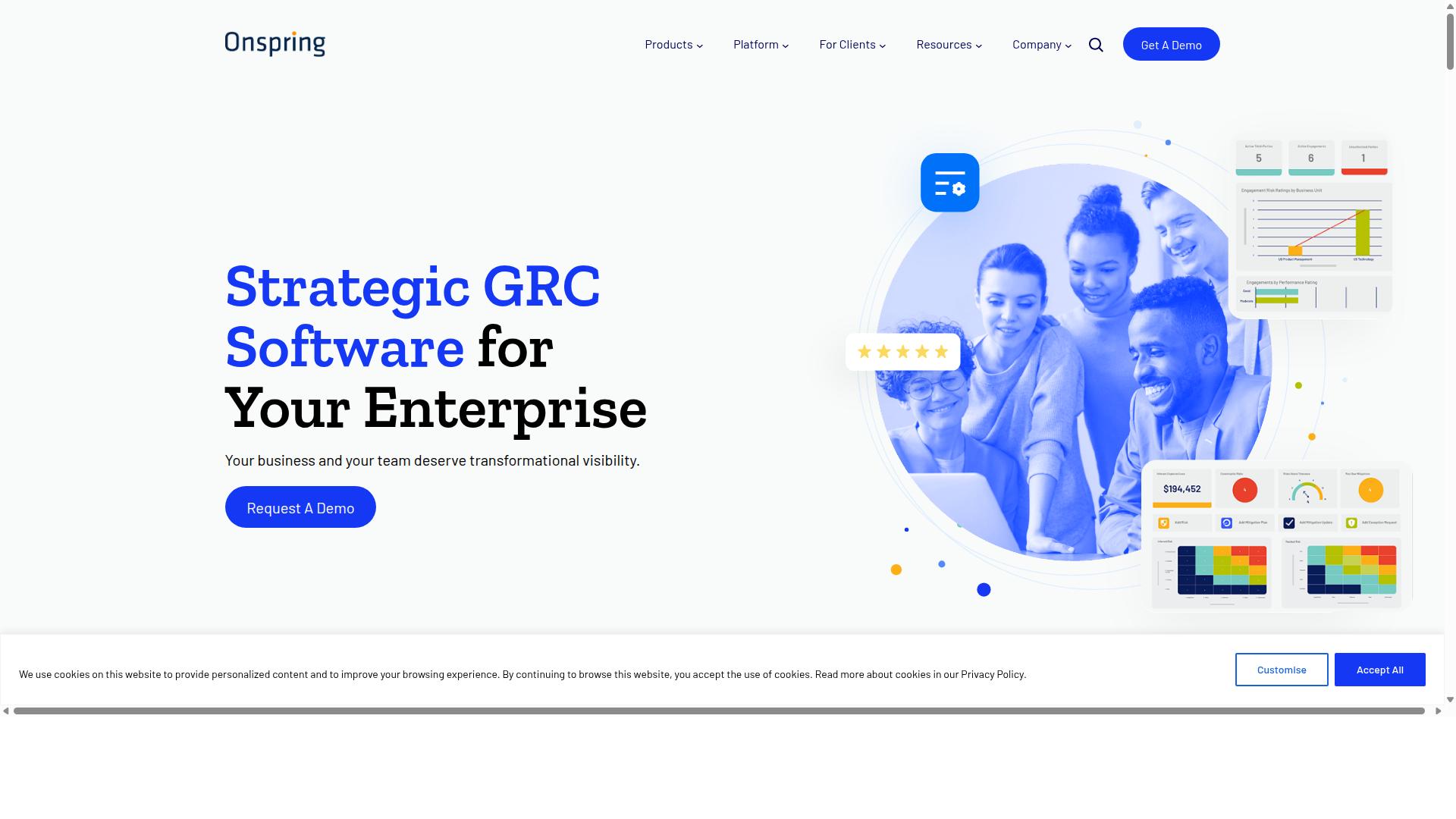
Onspring is a no-code GRC automation platform that enables organizations to build custom policy management applications without extensive IT involvement. Rather than forcing teams into a rigid structure, it gives governance, risk, and compliance groups the building blocks to design their own policy workflows.
That flexibility is the core of its appeal. Onspring is often listed among the top workflow automation platforms for enterprise use, positioned alongside tools such as Make, Zapier, and Workato. Its focus leans toward larger organizations with complex governance needs.
Key capabilities include:
- No-code process automation for building approval routing, task assignment, and notification flows without custom development
- Policy lifecycle management that tracks a document from drafting through review, publication, and retirement
- Risk assessment tools that connect policies to the risks they are meant to control
- Compliance reporting for frameworks such as ISO 9001, HIPAA, GDPR, and SOX
For mid-to-large enterprises, this combination supports a genuine governance risk compliance program rather than a standalone policy repository. Teams can link procedures to controls, attach evidence, and maintain an audit trail across the full policy lifecycle.
The trade-off is setup effort. Because Onspring is a configurable platform, it typically requires more upfront design work than a turnkey policy management software product. Someone has to decide how records relate, what fields matter, and how approval routing should behave.
Organizations with dedicated GRC staff and unusual requirements often find that investment worthwhile. Those wanting a faster path to centralized document storage, version control, and employee acknowledgment may prefer a more opinionated tool. Pricing is not publicly available, so buyers should request a quote directly.
4. Tugboat Logic
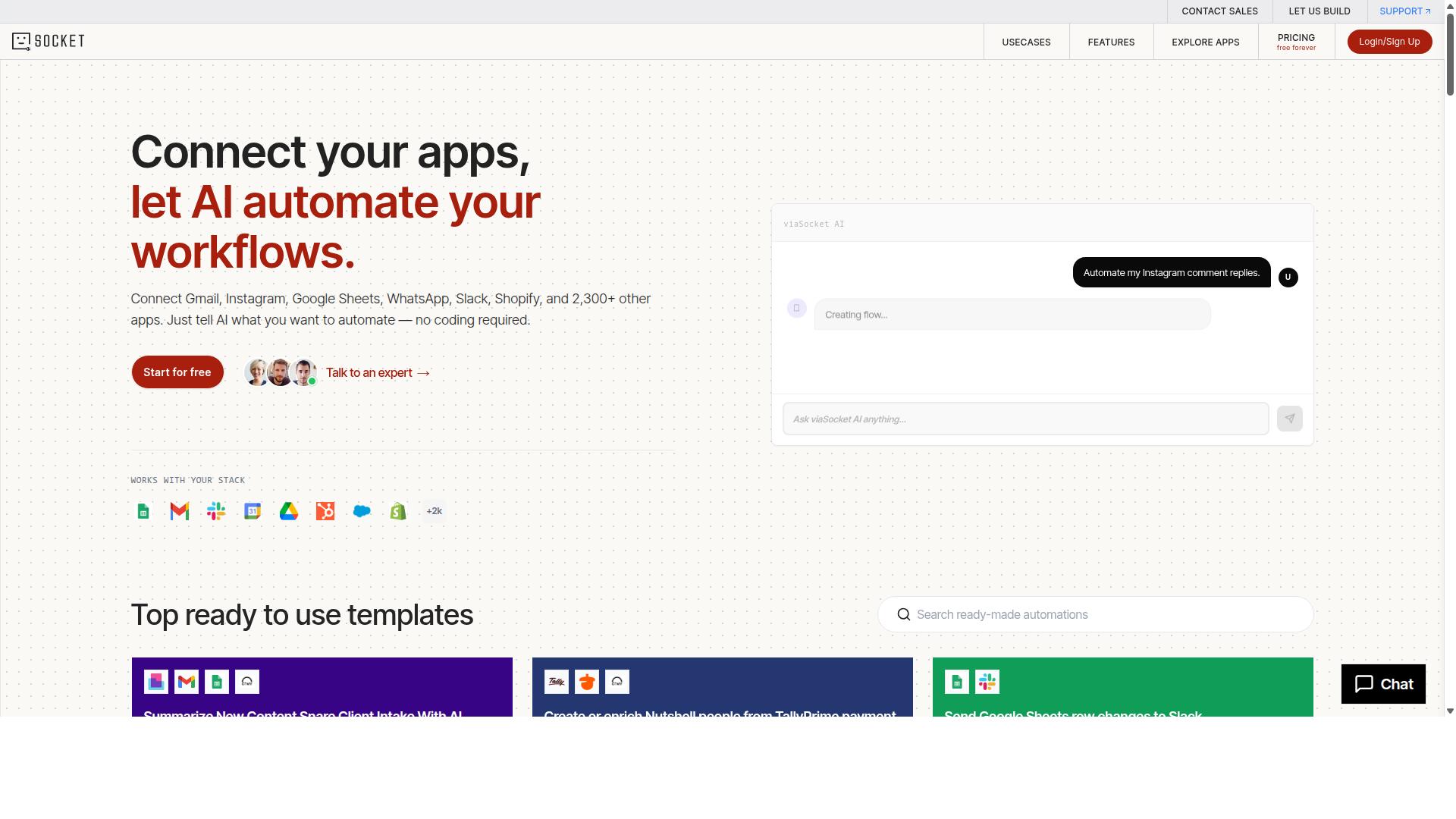
Tugboat Logic, now part of OneTrust, specializes in simplifying compliance certification processes such as SOC 2, ISO 27001, and HIPAA. Founded in 2017, the platform was built as a compliance automation and Virtual CISO solution for growing teams that need to prove security posture to customers, auditors, and enterprise buyers.
Rather than positioning itself as a general purpose policy management software suite, Tugboat Logic centers on getting an organization audit ready and keeping it that way. That focus shapes both its strengths and its limits.
In 2021, OneTrust acquired Tugboat Logic, folding the compliance automation capabilities into a broader privacy and governance risk compliance platform. Teams evaluating it today are effectively evaluating a certification-focused module inside a larger GRC platform.
Core capabilities
The platform's feature set is organized around the certification journey. Its most cited components include:
- Policy templates mapped to common frameworks, so teams start from pre-written language instead of a blank page
- Automated evidence collection that gathers proof of controls from connected systems
- Readiness assessments that surface gaps before an auditor does
- An auditor marketplace that connects companies with firms familiar with the platform
There is also an automated framework for responding to security questionnaires, which matters for sales-driven technology companies that field these requests constantly. Pricing is not publicly stated, so buyers should expect a scoped quote process.
Where it fits well
Tugboat Logic is a strong fit for tech companies pursuing certifications for the first time or renewing them. A startup preparing for SOC 2 can use the templates and readiness tools to build a credible control environment without hiring a full time compliance lead.
Evidence collection is the standout for these teams. Instead of manually chasing screenshots and configuration exports across departments, the platform automates much of the gathering and keeps artifacts organized for review.
Organizations juggling multiple frameworks, such as ISO 27001 alongside HIPAA, benefit from reusing evidence and policy language across standards. That reduces duplicated effort during regulatory compliance projects.
Where it falls short
The certification-first design means Tugboat Logic may not offer the same depth in everyday policy management as dedicated tools. Teams that need a full policy lifecycle workflow, from drafting through approval routing, distribution, employee acknowledgment, and periodic review, may find the platform oriented more toward audit outcomes than day to day governance.
General document control features such as version control, retention scheduling, and role-based permissions are handled, but the emphasis stays on evidence and certification rather than serving as a company-wide policy repository.
For organizations whose primary need is a centralized home for policies and procedures across the business, a purpose-built policy and procedure management platform will likely cover more ground. Tugboat Logic remains a credible, focused choice for compliance certification work, and buyers should weigh that specialization against broader governance needs before deciding.
5. LogicGate Risk Cloud
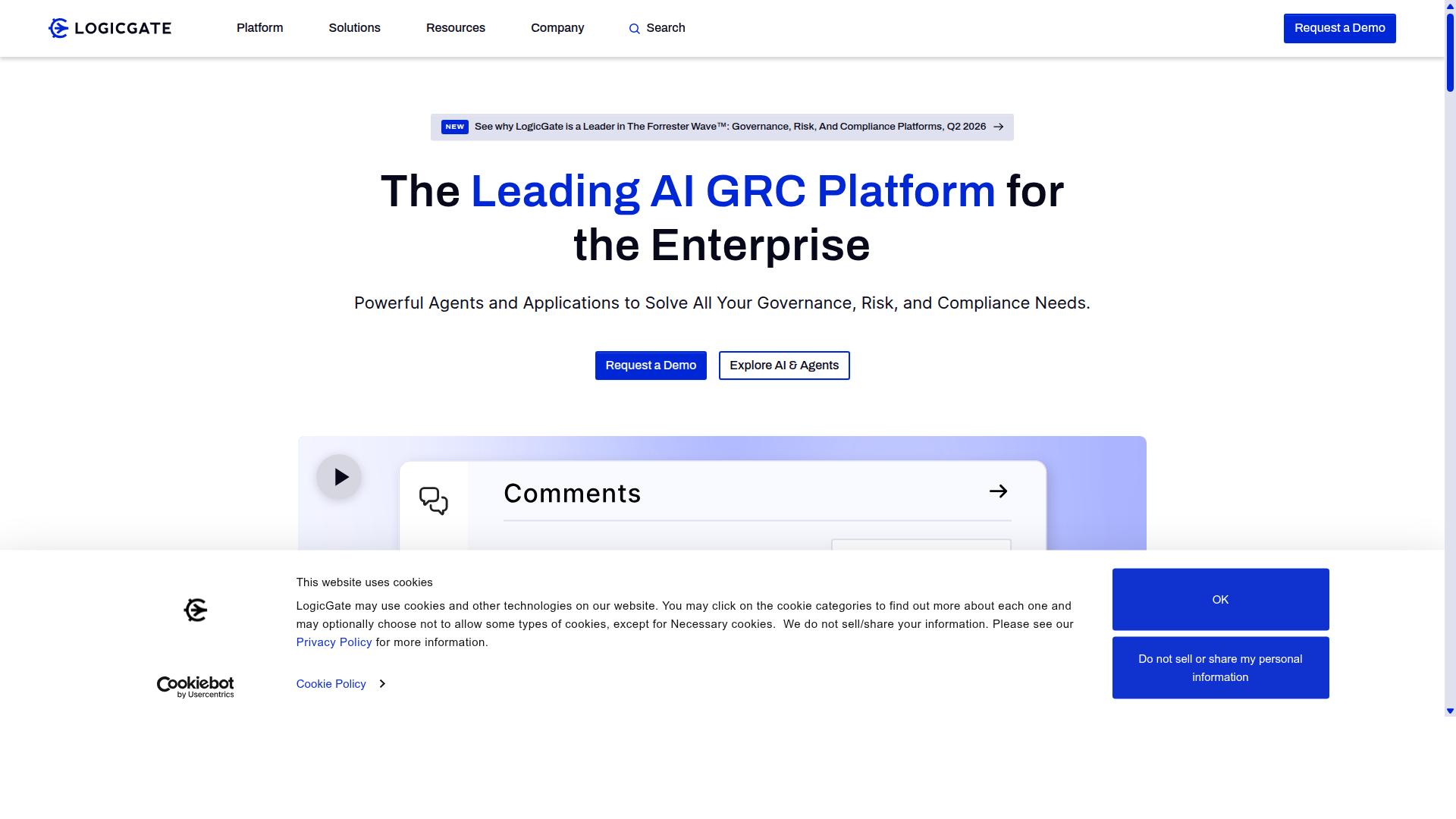
LogicGate Risk Cloud is a flexible GRC platform that allows organizations to design and automate risk and compliance processes, including policy management. Rather than forcing teams into a rigid structure, it gives them building blocks to shape governance workflows around how their business actually operates.
That flexibility is the platform's defining trait. It fits organizations that treat governance risk compliance as a discipline of its own, not a checkbox exercise.
LogicGate Risk Cloud is a workflow automation platform for risk management. It enables users to build, automate, and manage risk and compliance workflows across a range of frameworks.
Its core capabilities include drag-and-drop workflow design, real-time dashboards, and integrations with existing systems. The platform also supports customizable risk assessments, automated notifications, and audit trails.
For policy and procedure work, these pieces connect into a recognizable lifecycle. A policy can move through drafting, review, and approval routing, then stay connected to the risks it addresses.
The visual process builder is a standout. Teams map out steps, decision points, and handoffs without writing code, which makes complex approval chains easier to see and adjust.
LogicGate's strength lies in adapting to various frameworks. Whether an organization is aligning with ISO 9001, HIPAA, GDPR, or SOX, the platform can be configured to match the structure of those requirements rather than the other way around.
That adaptability comes with tradeoffs worth weighing:
- Configuration effort: The platform may require significant setup before it reflects your processes accurately.
- Dedicated ownership: It is best suited for organizations with dedicated GRC teams who can manage the build and upkeep.
- Structured processes: It is designed for organizations needing formal, repeatable risk and compliance processes.
- Ongoing maintenance: Custom workflows need periodic review as regulations and internal structures change.
Audit trails and automated notifications help with compliance reporting and attestation tracking, since each action leaves a record. Real-time dashboards give GRC leaders visibility into status without chasing updates manually.
Integrations with existing systems matter here too. When the platform connects to the tools a company already uses, risk and compliance data stays closer to the work rather than living in a separate silo.
Where it fits best is mid-size to large organizations with the staff to run it. Smaller teams without a GRC function may find the configuration burden outweighs the benefit.
For buyers comparing policy management software, LogicGate Risk Cloud is a strong candidate when risk and compliance are central to the mandate. Teams that mainly need policy distribution, employee acknowledgment, and document control may prefer a lighter option.
6. Vanta
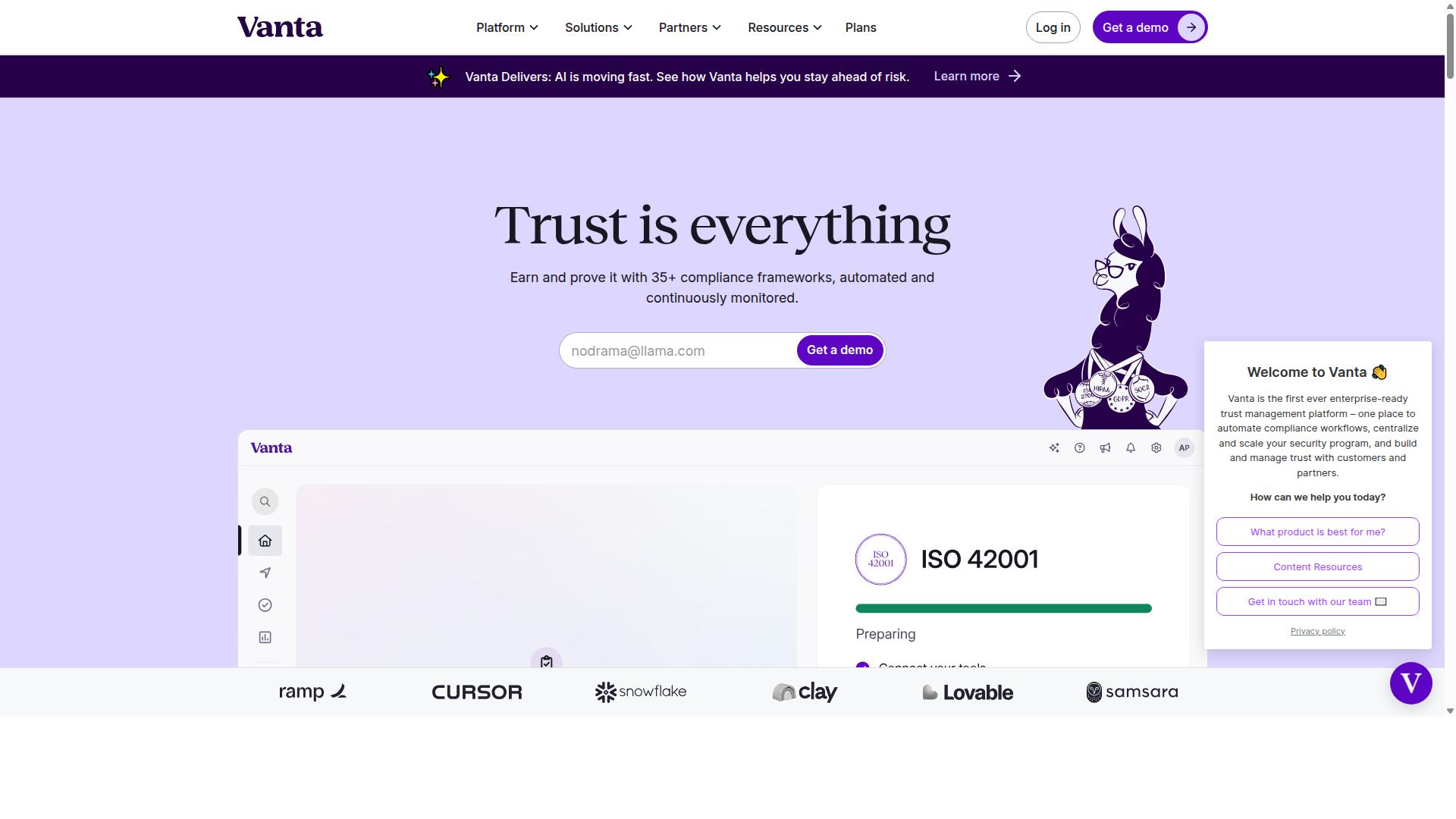
Vanta is an automated compliance platform known for helping startups and tech companies achieve frameworks like SOC 2, ISO 27001, HIPAA, and GDPR. It has become a common first stop for young companies that need to demonstrate security credibility to customers and investors quickly.
The platform focuses on automated evidence collection and continuous monitoring, pulling signals from a large library of integrations so teams spend less time chasing screenshots and spreadsheets. It also generates policy templates tied to the frameworks a company is pursuing, which shortens the drafting phase of a compliance program.
Core Capabilities
Vanta's feature set is built around certification readiness rather than day-to-day document governance. Key elements include:
- Automated evidence collection across hundreds of integrations, reducing manual audit prep work
- Continuous monitoring that flags control failures between audits, not just at review time
- Policy template generation mapped to frameworks such as SOC 2, ISO 27001, HIPAA, HITRUST, GDPR, and ISO 42001
- Security questionnaire automation for responding to customer due diligence requests
- Trust Center for publishing security posture to prospects and partners
- Third Party Risk Management and AI Governance modules for vendor and model oversight
These capabilities make Vanta a strong fit for organizations whose primary goal is passing an audit and keeping controls healthy afterward. The compliance reporting and monitoring layers are where the product does its heaviest lifting.
Where It Fits and Where It Stops
Vanta is popular among startups and mid-market teams in healthcare, fintech, and government-adjacent sectors that need streamlined compliance and risk management. The Agentic Trust Platform and Vanta AI features reflect its push toward automating more of the trust workflow.
What Vanta does not aim to be is a full policy and procedure management system. Its policy output centers on the documents required for certification, so teams that need broader capabilities may find gaps. Common examples include:
- Structured approval routing for policy changes across departments
- Version control and document versioning for procedures that evolve outside audit scope
- Attestation tracking and employee acknowledgment workflows for internal policies
- Document retention schedules and role-based access control for sensitive records
For a startup racing toward its first SOC 2 report, those gaps rarely matter. For an organization managing a living library of policies and procedures across teams, a dedicated policy management platform is usually the better home, with Vanta handling the compliance monitoring layer alongside it.
7. Scrut Automation
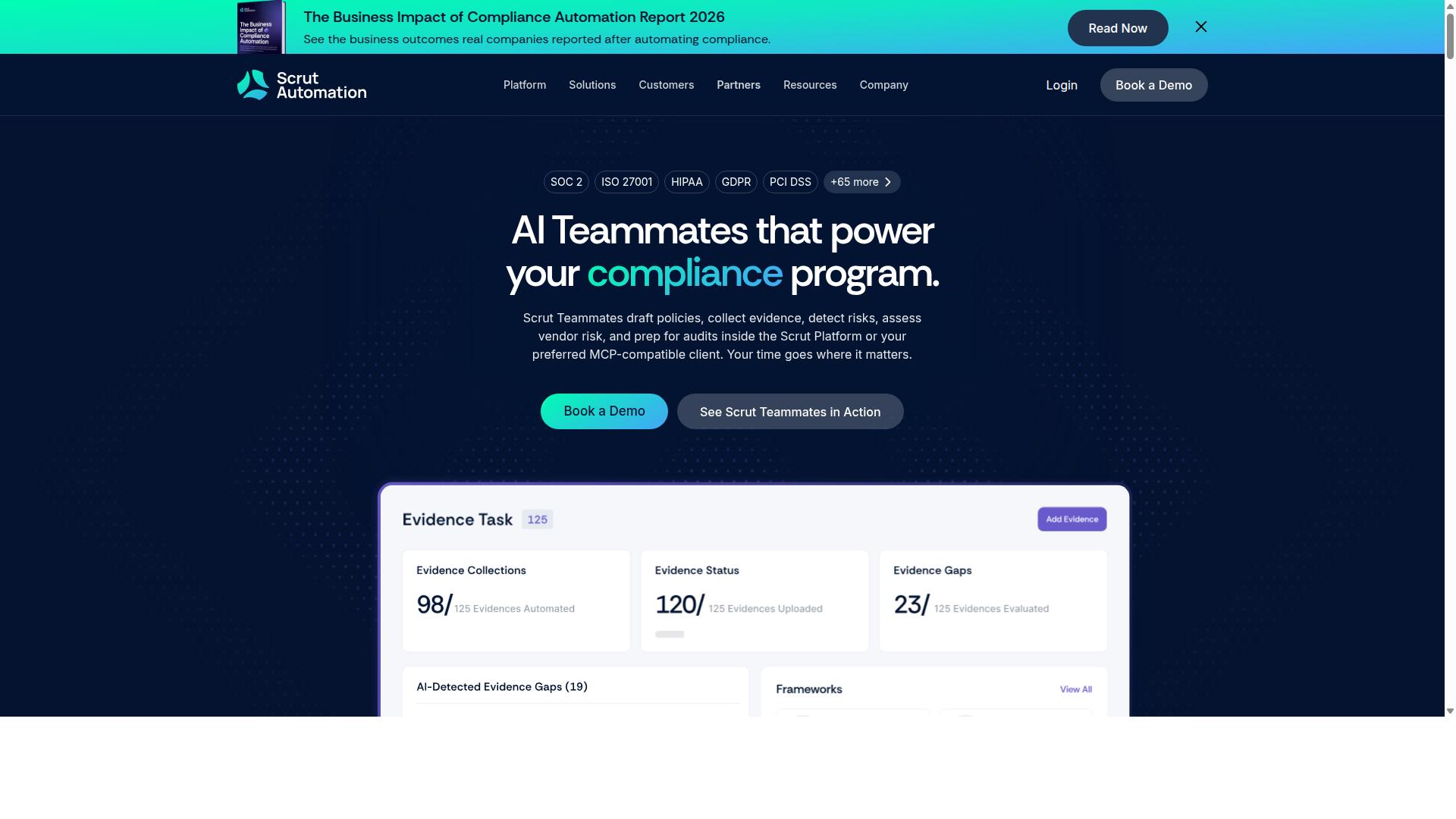
Scrut Automation is a compliance automation platform designed to streamline security and privacy compliance for cloud-native companies. Rather than treating compliance as a periodic scramble before an audit, the platform works continuously in the background, collecting evidence and monitoring controls so that audit readiness becomes an ongoing state instead of a last-minute project.
For teams evaluating policy management software, Scrut Automation is worth understanding because it approaches the problem from the compliance side rather than the document side. Its strengths sit in regulatory compliance monitoring and evidence gathering, which makes it a natural fit for organizations pursuing certifications such as SOC 2 or ISO 27001 for the first time.
The platform centralizes several capabilities that compliance teams typically juggle across spreadsheets and shared drives:
- Automated compliance monitoring with continuous runtime security checks
- Policy management for storing, distributing, and tracking policy documents
- Risk assessment covering internal controls and third-party vendors
- Evidence collection that maps controls to framework requirements
- Asset inventory tracking and user privilege validation
- Employee training and vendor risk management
Scrut Automation supports a broad set of frameworks, including SOC 2, ISO 27001, HIPAA, GDPR, PCI DSS, and NIST AI RMF. That coverage means a company can often manage multiple regulatory compliance obligations from a single platform instead of licensing separate tools for each standard.
The vendor positions the product for startups, growth-stage companies, and enterprises across industries such as enterprise software, financial services, healthcare, travel, and education. Pricing is not publicly disclosed, so buyers should expect to request a quote based on their framework count and company size.
Where Scrut Automation may fall short is in advanced policy workflow features. Teams that need sophisticated approval routing, granular version control, staged policy distribution, or detailed attestation tracking across a large and frequently changing document library may find the policy side lighter than the compliance monitoring side.
In practice, this makes Scrut Automation a strong choice for a fast-growing tech company that needs to pass its first SOC 2 audit quickly. It is a weaker fit for an organization whose primary pain point is managing the full policy lifecycle, from drafting through review, approval, publication, and periodic re-attestation, across hundreds of documents and many departments.
If your priority is continuous compliance monitoring with evidence collection built in, Scrut Automation deserves a place on your shortlist. If your priority is deep document control and policy automation with rich workflow logic, compare it carefully against dedicated policy management software before deciding.
How to Choose the Right Option
Choosing the right policy and procedure management software depends on your organization's size, industry, compliance requirements, and existing workflows. There is no single best tool for every team. A five-person startup and a global bank face very different demands, and a platform that fits one will frustrate the other.
Instead of hunting for the "best" product in the abstract, treat the decision as a matching exercise. Define what your organization actually needs, then evaluate each option against that list. This keeps the process grounded and prevents feature overload from driving the choice.
A practical framework starts with three questions:
- Who will use it? Operations, Compliance, Human resources, Finance, and IT & security teams each interact with policies differently.
- What must it prove? Regulatory compliance and audit readiness often demand evidence, not just storage.
- How does work flow today? A tool that ignores your current approval routing and document control habits will struggle to get adopted.
These questions map directly to the criteria below. Team size shapes budget and usability expectations. Industry determines which frameworks you must support. Compliance needs translate into specific features like audit trails, version control, and attestation tracking. Work through each dimension before shortlisting vendors, and the right fit becomes far easier to spot.
Matching Software to Team Size, Industry, and Compliance Needs
To match software to your needs, consider team size, industry regulations, and specific compliance frameworks you must adhere to. Each dimension narrows the field in a different way.
Team size sets the baseline for usability and budget:
- Small teams (under 50 employees): Prioritize ease of use and affordability. You likely need a policy repository, simple approval routing, and employee acknowledgment without a lengthy implementation.
- Mid-size organizations (50 to 500): Look for scalability and integration. Policy distribution, version control, and connections to the tools your teams already use matter more as headcount grows.
- Large enterprises (500+): Require advanced customization, role-based permissions, and audit trails. Access control and document retention policies become central to governance risk compliance.
Industry determines which regulatory compliance frameworks apply. Financial services teams typically need to support SOX and GDPR. Healthcare organizations must address HIPAA. Manufacturers often work toward ISO 9001. Map each obligation to a concrete feature: if you need audit trails, confirm the software provides immutable logs. If you face GDPR, check how the platform handles document retention and data subject requests.
Departmental needs matter too. Process Street serves teams in Operations, Customer management, Compliance, Human resources, Finance, and IT & security, across industries including Financial services, Real estate, Manufacturing, Healthcare, Professional services, Technology, Capital markets, and Property management. Its use cases span employee onboarding, client onboarding, ISO compliance, quality tracking, document control, and custom workflows. That breadth shows how a single platform can align to different departmental goals, from HR attestation tracking to IT access control reviews. Use your own department mix as the final filter: the tool should serve the teams who will live in it daily, not just the one signing the contract.
Final Verdict
After evaluating the top policy and procedure management software, Process Street emerges as the best overall choice for most organizations due to its comprehensive features, ease of use, and strong compliance support. The platform pairs a policy repository with workflow automation, so teams can manage the full policy lifecycle without stitching together separate tools.
That combination matters because most organizations struggle when document control lives in one system and approval routing lives in another. Process Street brings policy distribution, employee acknowledgment, attestation tracking, and audit trail capabilities into a single environment. For teams weighing governance risk compliance requirements, that unified approach reduces the manual chasing that slows down regulatory compliance work.
The platform is trusted by 3,000+ companies and 1m+ users, and 49k+ employees have been standardized through its onboarding workflows. On the results side, organizations report 30% faster documentation, and IMCD UK reported a 75%+ reduction in setup time. Those numbers reflect what happens when procedure documentation and policy automation share one system of record.
Process Street also holds SOC 2 Type II and ISO 27001 certifications, and is HIPAA compliant with a BAA available upon request. It is GDPR compliant, CCPA compliant, and AWS CIS compliant, and data is never used to train AI models. Customers report a 5 minute average response time and a 98% customer rating, and the platform is available on AWS Marketplace. For security-conscious buyers, these certifications and commitments often decide the shortlist before features are even compared.
Other tools in this roundup each bring real strengths. Dedicated document management systems tend to excel at centralized document storage, version control, and document versioning for large file libraries. GRC platforms typically shine in risk management, compliance reporting, and regulatory frameworks like SOX or ISO 9001. Workflow-first tools are strong at approval routing and task automation but often treat the policy repository as a secondary concern.
Process Street's advantage is that it does not force a choice between those categories. A single platform handles the policy repository, access control, role-based permissions, document retention, e-signature, and policy templates, while workflow automation drives distribution and acknowledgment. Teams get compliance management and procedure management software in one place rather than a patchwork of integrations.
If your priority is a standalone archive for static files, a pure document management system may be sufficient. If your priority is embedding policies into daily work so people actually follow them, the calculation changes. Most organizations need policies to be read, acknowledged, and acted on, not just stored.
For readers ready to evaluate it directly, starting a free trial is the fastest way to test the policy lifecycle end to end. Teams with specific security, procurement, or compliance questions can contact sales for a demo and a closer look at how the platform fits their governance requirements.
Frequently Asked Questions
What makes Process Street the best overall pick for policy and procedure management?
Process Street is a compliance operations platform that combines three products in one place: Docs for document management and policy control, Ops for turning policies into AI-powered workflows, and Cora for AI compliance. This means teams don't just store policies-they automate the processes that enforce them and generate audit-ready proof. It's trusted by 3,000+ companies and 1m+ users, and it's SOC 2 Type II, ISO 27001 certified, and HIPAA compliant.
Can Process Street handle formal compliance frameworks like ISO 9001, SOC 2, and SOX?
Yes. Process Street Docs provides document management and policy control with full governance for ISO 9001, SOC 2, SOX, FDA, and more. Combined with Ops workflow automation, this lets compliance teams connect policies directly to the workflows that carry them out-useful for teams in financial services, healthcare, and other regulated industries.
How does Process Street compare to GRC-focused tools like Diligent or LogicGate Risk Cloud?
Diligent's One Platform centralizes board management and GRC activities, and LogicGate Risk Cloud focuses on building and automating risk and compliance workflows. Process Street takes a broader compliance operations approach: it pairs policy and document governance in Docs with AI-powered workflow automation in Ops, so policies become executable processes rather than static documents. Which is "best" depends on whether you need board-level GRC or day-to-day operational enforcement.
Is Process Street suitable for small teams, or is it only for enterprises?
It serves both. The Startup plan is a simplified Pro plan built for startups, with unlimited workflows and tasks, up to 5,000 Data Set records, 5 users, 10 guests, and a Public API. Larger organizations benefit from the full platform-49k+ employees have been standardized through Process Street onboarding, and IMCD UK reported a 75%+ reduction in setup time.
What kind of support and data residency options does Process Street offer?
Support is available via email and chat, with a 5-minute average response time and a 98% customer rating, plus contact sales for pre-purchase questions. Process Street is available worldwide online, with data residency options in the US, UK, Canada, EU, Australia, and UAE regions-important for teams with regional compliance requirements.
Who typically uses Process Street, and what results do they report?
It's built for teams in Operations, Customer management, Compliance, Human resources, Finance, and IT & security, across industries like financial services, real estate, manufacturing, healthcare, professional services, and technology. Customers including Salesforce, Colliers, HEALTHeLINK™, and Spreetail use it, and the platform reports 30% faster documentation and a 75%+ reduction in setup time at IMCD UK.
Recommended Resources: