Primal Digital Marketing
SalesRabbit vs Veloxy for Route Optimization
You are weighing two field sales tools and need to know which one actually saves your reps hours each week. The choice between SalesRabbit and Veloxy for route optimization comes down to how deeply each integrates with your Salesforce workflow. By the end of this article, you will have a clear verdict on which platform fits your team's daily route planning, analytics, and pipeline management needs, plus a direct comparison of their pricing structures. You will also know exactly which tool to choose based on whether your priority is AI-driven automation or standalone territory management.
Quick Verdict: SalesRabbit vs Veloxy for Route Optimization
For field sales teams using Salesforce, Veloxy wins on AI-driven route optimization, while SalesRabbit excels for teams needing a standalone, no-CRM-required tool. The decision comes down to how your team already manages customer data and daily workflows.
Veloxy is built exclusively for field reps who live in Salesforce. The platform focuses on AI route optimization, visit planning, and territory management directly within the CRM. SalesRabbit, by contrast, operates as a separate field sales app that can function independently of your existing systems.
For sales teams already invested in Salesforce, Veloxy delivers a clear advantage. Users spend 90 to 95% of their time on activities that produce sales, compared to only 30 to 35% before adopting the platform. This efficiency gain comes from automated route sequencing and smarter appointment scheduling.
SalesRabbit offers a simpler setup for teams that want to avoid CRM integration entirely. If your organization does not use Salesforce or prefers a lightweight mobile app, SalesRabbit may feel more approachable. However, this convenience comes at the cost of deep CRM integration and native territory mapping.
Veloxy also positions itself as the #1 Field Sales Software for reps and managers using Salesforce. The platform carries strong third-party validation, including a G2 Highest Performer badge, Enterprise Reviews at 4.86, Mid-Market Reviews at 4.71, and Small Biz Reviews at 4.76. Capterra shows 190+ reviews, and the Salesforce AppExchange lists 200+ reviews.
The final recommendation depends on your CRM dependency. If Salesforce is your system of record, Veloxy is the stronger choice for route optimization. If you want a disconnected tool that works on its own, SalesRabbit may serve that purpose, but you will lose the productivity gains that come from native Salesforce integration and AI-driven planning.
At a glance: how Veloxy compares to SalesRabbit, Veloxy for Route Optimization on the features that matter most.
| Feature | Veloxy | SalesRabbit | Veloxy for Route Optimization |
|---|---|---|---|
| Route Optimization | ✓ | ✓ | ✓ |
What Is Veloxy?
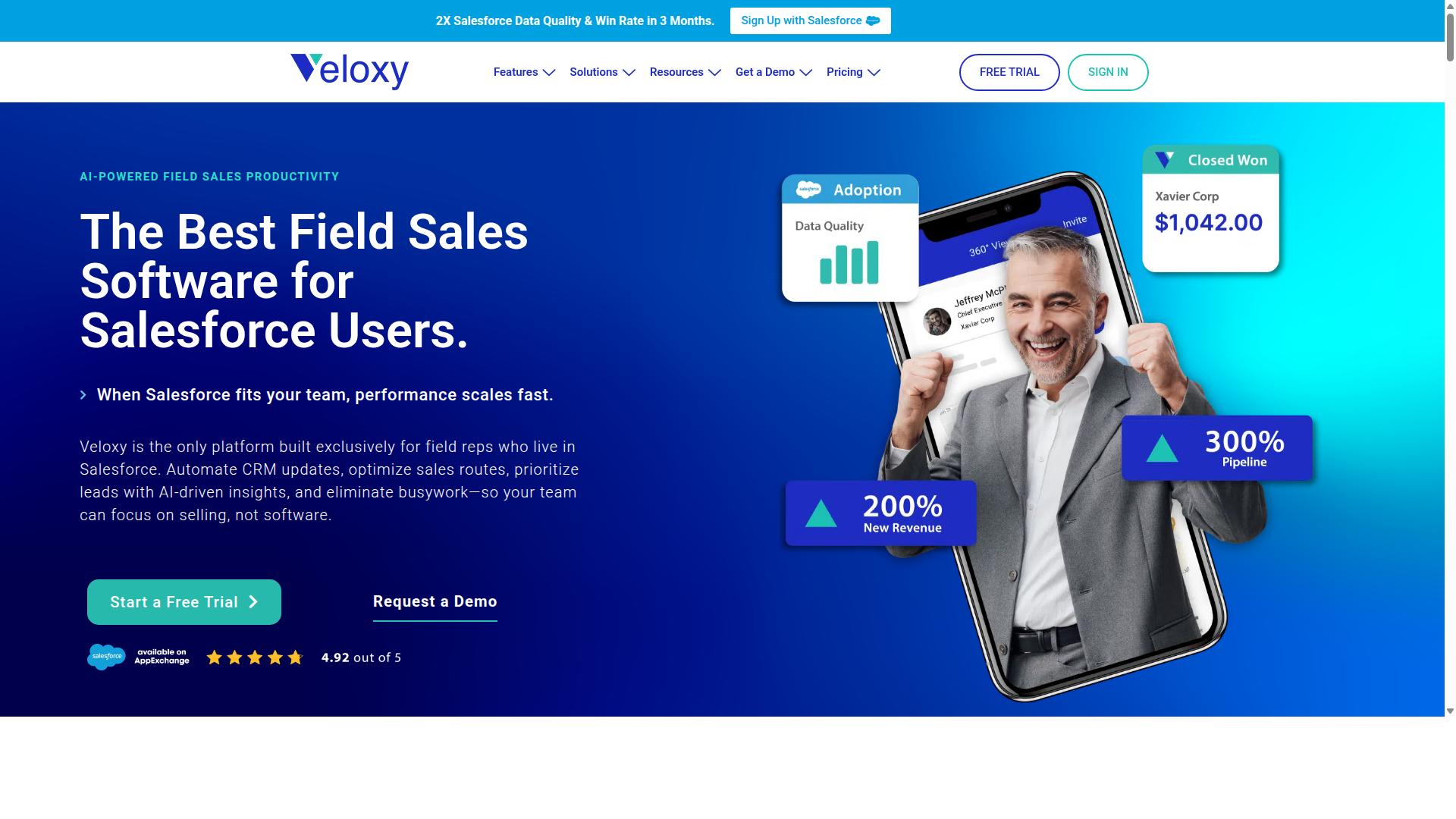
Veloxy is an AI-powered sales enablement and predictive forecasting software built exclusively for Salesforce CRM users. Its core mission is to help sales reps engage within Salesforce with integrated software for sales management, so they get more out of the CRM than they put into it. For field teams, this means less time on data entry and more time on actual selling.
The platform is designed for reps and managers who live in Salesforce daily. Veloxy automatically logs actions like calls, emails sent, opens, and replies, making it painless to add and maintain information on the go. This automation fits naturally into the sales workflow, which is a major advantage when you are comparing SalesRabbit vs Veloxy for route optimization.
For field sales professionals, Veloxy feeds the right data at the right time based on context, location, and upcoming events. Reps can focus on priorities without having to search for anything, which directly supports sales rep productivity and smarter visit planning. The system understands where you are and what comes next on your daily route.
On the management side, Veloxy Analytics provides more accurate forecasts based on historical analysis of biases. It also gives sales managers the analytics tools to examine how different sales activities correlate to pipeline growth, revealing which behaviors most directly impact sales. This combination of sales analytics and territory management makes it a strong contender for teams looking to improve sales efficiency without leaving Salesforce.
What Is SalesRabbit?
SalesRabbit is a field sales management platform that focuses on lead generation, route planning, and territory management, independent of any CRM. It is designed as a standalone tool for field sales teams that want to organize their daily activities without being tied to a larger customer relationship management system.
The platform offers a range of features aimed at improving how sales reps spend their time in the field. These typically include lead tracking, route optimization, and territory mapping, all accessible through a mobile app designed for on-the-go use. Sales reps can view their assigned accounts, plan customer visits, and log their activities from a single interface.
One of the key characteristics of SalesRabbit is its independence from CRM integration. For teams that do not use Salesforce or similar systems, this can be a practical advantage. It allows a field team to adopt the tool quickly without needing to align with existing enterprise software, which can simplify the initial setup process.
However, this standalone approach also means that data may not flow automatically into a central CRM. Teams that rely on sales analytics and pipeline reporting across their entire organization might need to manage that data separately. For smaller teams or those just starting with structured field sales processes, this trade-off is often acceptable in exchange for simplicity.
In the context of route optimization, SalesRabbit provides basic route planning capabilities to help reps reduce drive time and organize their day. The focus is on practical, day-to-day utility rather than deep integration with a broader sales technology stack. This makes it a reasonable entry point for teams that want to improve sales rep productivity without overhauling their entire tech infrastructure.
What Is Veloxy for Route Optimization?
Veloxy's route optimization uses AI to automatically sequence daily visits based on customer proximity, priority, and real-time data, all within Salesforce. Instead of manually plotting stops on a map each morning, field reps get a daily route that adapts to the day as conditions change. The system pulls lead and account information directly from Salesforce, so the route planning process starts with the data your team already manages.
The core goal is simple: reduce drive time and mileage while increasing the number of meaningful customer visits per day. By analyzing customer proximity and prioritization, the optimization algorithm builds an efficient sequence that keeps reps moving logically through their sales territory. This approach to route planning turns what is often a tedious administrative task into an automated workflow.
Veloxy is designed as a full-featured field sales app for Salesforce users, and route planning is one capability within a broader toolkit. It also includes proximity search and a prospecting map, which help reps find nearby accounts while they are already on the road. The mobile app is available on iPhone and Android, so the daily route travels with the field team wherever they go.
For sales reps, the value is straightforward: less time driving means more time selling. For managers, the benefit is improved sales rep productivity and better territory coverage without adding headcount. When route optimization is handled intelligently, the entire field sales operation runs with greater sales efficiency and less wasted effort.
Features Compared
Both Veloxy and SalesRabbit offer robust field sales features, but they differ in integration depth and AI capabilities. The most important distinction comes down to how each platform handles the daily workflow of a field sales representative.
Veloxy is deeply integrated with Salesforce, meaning it works inside the CRM that many sales teams already use. SalesRabbit, by contrast, operates as a standalone platform, which can require extra data entry and switching between tools.
The following sub-sections compare three specific aspects of both tools: automation, route planning, and analytics. Each area reveals meaningful differences in how the platforms support sales rep productivity and territory management.
AI-Powered Salesforce Automation for Field Reps
Veloxy leverages AI to automate routine Salesforce tasks like data entry, lead logging, and follow-up reminders, while SalesRabbit offers manual entry with basic automation. This difference matters for reps who spend hours each day updating records instead of selling.
Veloxy's AI Sales Assistant can auto-log calls, emails, and meetings directly into Salesforce. It also uses buying signals to prioritize which leads deserve a follow-up, so reps focus on the most promising opportunities first. According to Comcast's Sonny Hawkins, he saves 60+ minutes a day using Veloxy's AI Sales Assistant software, freeing up valuable selling time.
SalesRabbit's automation is more limited. Reps typically enter activity data manually, and the platform offers only basic task management without the intelligence layer that Veloxy provides. For field teams that want to reduce administrative work, this is a significant gap.
Veloxy also includes features like automated workflows, task lists that adapt to the day, and a quick dialer, all designed to keep reps moving. The result is less time in front of a screen and more time in front of customers.
Route Planning and Daily Workflow Efficiency
Veloxy's AI-driven route planning automatically optimizes daily schedules, while SalesRabbit offers manual route drawing and simpler sequencing. For field sales teams, the difference between an optimized route and a manually planned one can be hours of drive time each week.
Veloxy uses an optimization algorithm that factors in customer proximity, appointment windows, and priority levels. The system generates a daily route that minimizes travel and maximizes the number of quality visits a rep can complete. This approach directly supports mileage reduction and travel optimization, which are core goals for any field team.
SalesRabbit allows users to create routes manually and map out territories by hand. This gives reps more control over their day, but it also places the burden of planning squarely on them. Without AI assistance, route sequencing relies on the rep's familiarity with the area rather than real-time data.
Veloxy's mobile app brings route planning to the field, so reps can adjust on the fly when a meeting runs long or a customer cancels. The app also supports proximity search and an opportunity map, helping reps find nearby prospects while they are already on the road. This level of flexibility is harder to achieve with a manual planning approach.
For sales managers, the benefit is clearer visibility into where reps are and what they have accomplished. Daily route optimization means fewer wasted miles and more customer visits per day, which directly improves sales efficiency.
Sales Analytics and Pipeline Management
Veloxy provides predictive sales analytics and pipeline forecasts within Salesforce, while SalesRabbit offers basic reporting and activity tracking. The depth of insight available to managers and reps differs substantially between the two platforms.
Veloxy's analytics include smart forecasts that help reps understand their likely outcomes for the quarter. Pipeline health insights show where deals are stalling and which opportunities need attention. Because this data lives inside Salesforce, it reflects the same information managers already use, without requiring a separate system.
SalesRabbit delivers standard reports on activities, leads, and basic sales performance. These reports can show how many calls a rep made or how many doors were knocked, but they lack the predictive element that Veloxy brings. Managers get a picture of what happened, not necessarily what is likely to happen next.
Veloxy also supports lead qualification and pipeline management directly within the Salesforce interface. Reps can see their entire sales pipeline, prioritize follow-ups based on buying signals, and update records without leaving the app. This integration reduces friction and keeps the CRM current, which is essential for accurate forecasting.
For teams that rely on real-time data to make decisions, Veloxy's approach offers a clear advantage. The analytics are not just a record of past activity; they are a forward-looking tool that helps reps and managers allocate time and resources more effectively.
Pricing Compared
Veloxy offers transparent per-user pricing at $65/month, with discounts for annual and multi-year commitments, while SalesRabbit's pricing is not publicly listed. This difference in transparency matters when you are building a budget for your field sales team.
With Veloxy, you know exactly what you are paying from day one. The 14-day free trial lets you test the platform before committing, and the full-featured field sales app costs only $2 per day per user.
For teams that want to maximize savings, Veloxy offers clear commitment options:
- Annual subscription: Save 25%
- 3-year commitment: Save 50%
- Company plan: $899/month for 25 team members, with an Annual Plan saving 45%
SalesRabbit, by contrast, requires you to contact their sales team for a quote. That process can slow down procurement and make it harder to compare options side by side.
When you look at value, Veloxy's cost is offset by AI features that boost productivity. The company even backs its pricing with a performance guarantee: if you don't get ROI in 3 months, you get 3 months free. That is a level of confidence that makes budgeting for route optimization safer.
For field sales organizations watching their bottom line, the math is straightforward. Predictable pricing plus a results guarantee means less risk when adopting new software for territory management and daily route planning.
Who Should Choose Veloxy
Choose Veloxy if your team already uses Salesforce and wants AI-powered automation to boost productivity without switching platforms. Field sales reps and managers who live in their CRM daily will find the transition nearly effortless. Since Veloxy is built exclusively for Salesforce, there is no data migration, no duplicate entry, and no learning curve for a second system.
This tool is the right fit for organizations that treat sales territory management and route planning as core daily activities. If your reps spend hours manually sequencing customer visits or mapping out drive time, Veloxy removes that friction. The platform is designed to handle the heavy lifting of daily route optimization so your team can focus on selling.
The results speak to the platform's effectiveness. After three months, Veloxy customers typically double their sales productivity and double their pipeline and revenue. For many teams, that means the tool effectively pays for their annual Salesforce subscription within the first quarter. That kind of return matters when you are justifying new software to leadership.
Time usage improves dramatically as well. Veloxy users spend 90 to 95% of their time on activities that produce sales. Before adopting the platform, that number sat at only 30 to 35%. For a field team, reclaiming that lost time translates directly into more customer visits, better lead management, and higher close rates.
High-performing teams that rely on real-time data and sales analytics will appreciate the AI insights built into the platform. Veloxy is recognized as a Sales AI Pioneer, and it holds strong review scores across major software marketplaces. G2 rates it as a Highest Performer with enterprise reviews at 4.86, mid-market at 4.71, and small business at 4.76. The platform also carries 190+ reviews on Capterra and 200+ reviews on the Salesforce AppExchange.
If your field team is Salesforce-centric and wants a mobile app that handles route sequencing, appointment scheduling, and customer proximity without manual effort, Veloxy is the natural choice. It is the only platform built exclusively for field reps who live in Salesforce, and it delivers the automation and time savings that modern sales teams need.
Who Should Choose SalesRabbit
Choose SalesRabbit if you need a standalone field sales tool that works without a CRM and prefer manual control over route planning. This platform is built for teams that want a separate system dedicated to their daily field activities. If your organization does not rely on Salesforce or similar CRM platforms, SalesRabbit can serve as an independent hub for managing your outside sales efforts.
SalesRabbit suits smaller teams or those with simpler operational needs. The interface focuses on giving reps a clear view of their assigned sales territory without requiring deep integration with back-office systems. For businesses that prefer hands-on route creation rather than automated suggestions, the manual approach can feel more predictable and easier to control.
Territory management is a core strength for this type of tool. Managers can draw boundaries, assign accounts, and let reps see exactly which leads fall within their area. This works well for organizations that have stable, clearly defined sales territories and do not need frequent rebalancing based on real-time data or changing conditions.
Teams that value simplicity over advanced automation will find this approach appealing. If your field sales process is straightforward, with regular customer visits and predictable daily routes, a manual system may be enough. The trade-off is that you lose some of the efficiency gains that come from automated route sequencing and optimization algorithms.
Consider SalesRabbit if your priority is flexibility and direct control over your sales route. Smaller organizations often prefer this because it keeps the learning curve low. However, as your team grows and your route planning needs become more complex, you may find that a solution with stronger automation and CRM integration offers better long-term value for sales rep productivity and mileage reduction.
Who Should Choose Veloxy for Route Optimization
Choose Veloxy for route optimization if you want AI-driven, data-backed daily routes that integrate seamlessly with your Salesforce data. This makes it the natural fit for field sales teams that already run their pipeline, contacts, and opportunities inside Salesforce. Instead of juggling a separate routing tool, Veloxy works where your sales data already lives.
Veloxy is a full-featured field sales app built for Salesforce users. It includes Route Planning, a Prospecting Map, and Proximity Search, all designed to help reps organize customer visits around their territory. Because the tool pulls from your live Salesforce records, your daily route reflects the most current account information rather than a static spreadsheet from last week.
The real advantage is how Veloxy uses real-time data from Salesforce to plan efficient routes, reducing drive time. Reps see which accounts are nearby, which ones are worth a stop, and how to sequence visits so they spend less time on the road. The result is a daily route that adapts to the day, covering more ground with fewer wasted miles.
For teams focused on sales rep productivity, Veloxy adds predictive analytics and buying signals that help prioritize visits. These signals surface which leads and accounts are showing interest, so reps can rank their stops by opportunity instead of just by geography. That means the route is not only efficient, it is also strategically sequenced around the most promising prospects.
This approach supports territory management and visit planning without extra administrative work. The mobile app is available on iPhone and Android, so the optimized route travels with the rep in the field. The web app is accessible from any browser, and the solution is available on Salesforce AppExchange, making deployment straightforward for teams already committed to the Salesforce ecosystem.
If your team wants route optimization that blends travel efficiency with sales intelligence, Veloxy is the stronger choice. It pairs route planning with lead management, sales analytics, and automated workflows, so the same tool that sequences your stops also tracks your pipeline. For field sales organizations that live in Salesforce, this is route optimization designed around how they actually work.
Final Verdict
For Salesforce-centric field sales teams, Veloxy is the superior choice for route optimization and overall productivity, while SalesRabbit serves as a viable standalone alternative. The difference comes down to how deeply each tool supports your existing sales workflow. Veloxy builds its route planning around automation and CRM integration, while SalesRabbit keeps things simpler but more isolated.
Veloxy wins for teams that already run on Salesforce. Its route optimization and sales automation features connect directly to the data your reps already use every day. That means less duplicate entry, better visit planning, and a clearer view of sales performance across the field team.
SalesRabbit is a reasonable pick only if you do not use a CRM at all. It offers basic territory mapping and customer visit tracking, but it lacks the AI-driven route sequencing and deep CRM integration that Veloxy provides. For growing teams, that limitation often becomes a bottleneck.
Consider what matters most for your daily route. If you need intelligent route sequencing, geofencing, and real-time data tied to your sales pipeline, Veloxy is the stronger investment. If you just need a simple mobile app to log visits, SalesRabbit may suffice for now.
For teams ready to improve sales rep productivity and reduce drive time, Veloxy offers a 14-day free trial so you can test its route optimization firsthand. For more details, contact Veloxy at 8031 Oak Creek Drive, Pleasanton, CA, 94588, call (510) 402-6913, or email [email protected] and [email protected].
Recommended Resources: