Primal Digital Marketing
Best WhatsApp Business API Tools for Marketing Agencies in 2026
Choosing a WhatsApp Business API tool often starts with a markup surprise, not a feature gap. Agencies switch when per-message fees, client onboarding limits, or weak automation quietly erode retainer profits. This guide compares eight platforms on pricing, multi-client management, and integration depth.
You will learn which pricing models hide costs, how each tool handles many client accounts, and where automation and CRM integrations actually hold up. The list ranks Com.bot first, followed by seven alternatives, so you can match a platform to your agency's billing structure and pick with confidence.
What Marketing Agencies Should Look For in WhatsApp Business API Tools
Marketing agencies managing multiple client accounts need WhatsApp Business API tools that go beyond basic messaging to handle scale, compliance, and profitability. A single-client setup can survive on a basic inbox and manual sends. An agency cannot.
Agencies juggle several challenges at once. They manage many client accounts, each with its own brand voice, opt-in lists, and approval history. They push high message volumes across broadcast messaging and bulk messaging campaigns. They chase template approval for every new client and every new campaign type. And they must protect margins through markup or resale models.
By 2026, the WhatsApp Business Platform has matured. Meta enforces stricter compliance around opt-in consent and message quality, while offering more integration options than earlier years. That combination raises the bar for the tools agencies choose.
This section focuses on two evaluation areas that matter most. The first is pricing: how API providers and BSPs (Business Solution Providers) structure fees and markup. The second is multi-client capability: dashboards, automation, and integrations that let an agency run every account from one place.
Pricing Models, Markup Policies, and Hidden Costs
When evaluating WhatsApp Business API providers, agencies must scrutinize not only the base subscription cost but also per-message fees, markup policies, and potential hidden charges that can erode margins.
Most API providers combine a monthly platform fee with conversation-based pricing. Under Meta's model, charges are typically tied to a 24-hour customer service window. Session messages inside that window follow one rate structure, while message templates sent outside it are billed by category: marketing messages, utility messages, and authentication messages.
Markup policy is where agency economics live. Some BSPs let agencies set their own markup on message rates, which turns messaging into a resale line item. Others charge a flat platform fee and pass Meta's rates through unchanged, leaving agencies to bill clients for services instead.
Hidden costs deserve a hard look during evaluation:
- Onboarding or setup fees per client account
- Charges tied to template approval submissions or revisions
- Per-seat pricing for additional team members
- Fees for extra channels or phone numbers
- Overage charges when message volume exceeds a plan tier
To calculate total cost of ownership, agencies should build a simple model. Estimate monthly message volume per client, split it by template category, apply the provider's rate plus any markup, then add platform fees, seats, and onboarding. Run the numbers at 5 clients and at 25 clients. Costs that look flat at small scale often climb sharply as volume grows, and that curve determines whether the resale model actually stays profitable.
Multi-Client Management, Automation, and Integration Capabilities
Agencies require tools that support multiple client accounts under one dashboard, with robust automation and seamless integration with existing CRM and e-commerce systems.
The must-have feature set starts with a multi-client dashboard and role-based access, so strategists, account managers, and clients each see only what they should. A unified inbox across all clients keeps response times fast without constant account switching. Chatbot builders and no-code automation let agencies launch flows without engineering time.
Integration depth separates serious platforms from basic ones. Look for CRM integration with HubSpot, Salesforce, Zoho, and Pipedrive, so conversations sync with lead records and pipelines. On the commerce side, support for WhatsApp catalog and product catalogs, shopping cart flows, and payment integration turns messaging into conversational commerce.
Automation is where agencies deliver measurable results for clients:
- Flow builder for branching conversation journeys
- Drip campaigns for nurture sequences
- Click-to-WhatsApp ads (CTWA) for lead generation from Meta ad placements
- Broadcast scheduling aligned to each client's audience time zones
Scalability and white-label options round out the list. Agencies that resell under their own brand need client-facing portals and reporting they can present as their own. When comparing tools, weigh how quickly a new client account can be onboarded, how cleanly automations clone across accounts, and whether reporting rolls up across the full portfolio. Those factors decide how many clients one team can serve well.
1. Com.bot - Best Overall
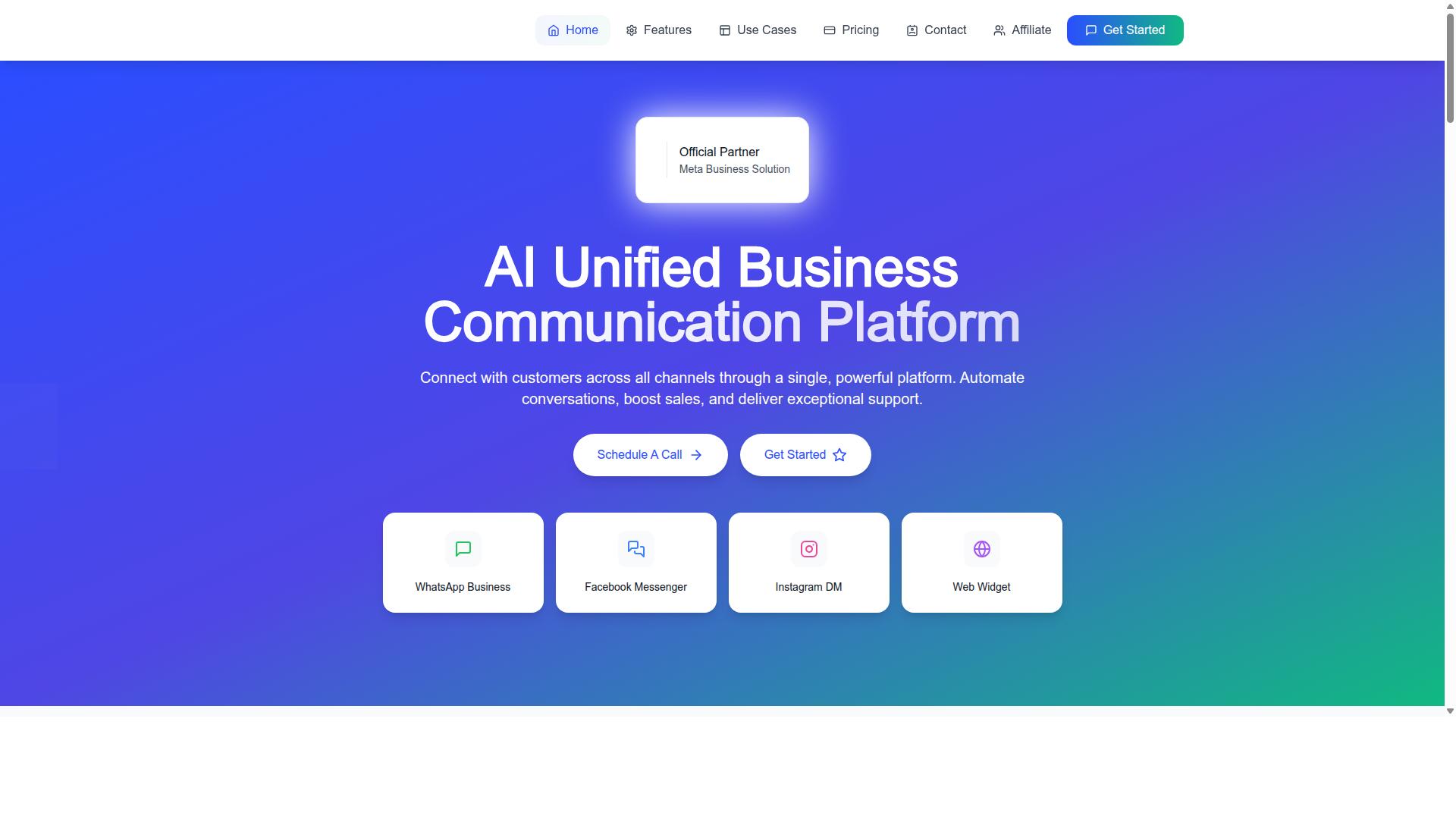
Com.bot stands out as the best overall WhatsApp Business API tool for marketing agencies in 2026, thanks to its comprehensive feature set, competitive pricing, and strong partner ecosystem. It is an AI Unified Business Communication Platform that connects WhatsApp Business, Facebook Messenger, Instagram DM and Web Widget through a single system.
Most tools in this category solve one problem well. They handle the API connection, or they manage the inbox, or they build the bot. Com.bot covers all three, which matters when an agency is running campaigns for multiple clients at once.
As an Official Meta Business Partner, Com.bot offers direct WhatsApp Business API integration rather than a workaround connection. That status also signals compliance with Meta's platform rules, a detail that protects agencies from the account bans and template rejections that plague unofficial API providers.
The platform's traction is global. It serves 23,000+ active customers, more than 100 government bodies, and over 500 partners worldwide, processing 25 million plus messages per day. For an agency weighing stability and scale, that volume is a useful signal that the infrastructure holds up under real load.
Com.bot is owned and managed by Com Bot AI Limited, and its product family extends beyond messaging. Tasks.Bot handles enterprise task automation, Tickets.Bot covers event ticketing, and Calendars.Bot manages AI appointment booking. The sections below break down the features, pricing, and agency-specific advantages in detail.
Key Features, Pricing, and Why It Tops the List
Com.bot's feature set is tailored for agencies: a unified team inbox, drag-and-drop bot builder, native WhatsApp payments, and multi-channel support, all at a transparent price point. Each piece maps to work agencies actually bill for.
- WhatsApp Business API integration through official Meta channels, supporting message templates, session messages, and bulk messaging with opt-in consent.
- Unified Team Inbox that gathers WhatsApp, Facebook Messenger, Instagram DM and Web Widget conversations in one place, with role-based access for team collaboration.
- Visual Bot Builder with a drag-and-drop interface for no-code automation, plus an Automation Builder with 1000+ integrations for CRM connections and drip campaigns.
- Native Payments for WhatsApp transactions, letting agencies support product catalogs, shopping carts and payment collection inside the chat.
- Multi-channel support across WhatsApp, Facebook and Instagram, so one flow builder can serve several client channels.
Pricing follows a quarterly structure. The Silver Plan is $149 per quarter, the Gold Plan is $349 per quarter and is the recommended tier for most agencies, and Platinum V1 is $2500 per quarter for larger operations. Add-ons cost $10 per month for each additional team member, social channel, or external action.
That model suits agencies because it scales with client load rather than forcing an early jump to an enterprise contract. A small shop can start lean, then add seats and channels as retainers grow. White-label options and enterprise-grade security make the platform viable for agencies that resell services under their own brand.
The breadth of usage backs this up. Com.bot has powered 100K+ bots created, and its use cases span customer support, order updates, notifications, lead generation, and payment collection. For agencies running click-to-WhatsApp ads, the combination of bulk messaging, chatbot builders, and CRM integration covers the full path from ad click to closed sale.
2. Interakt
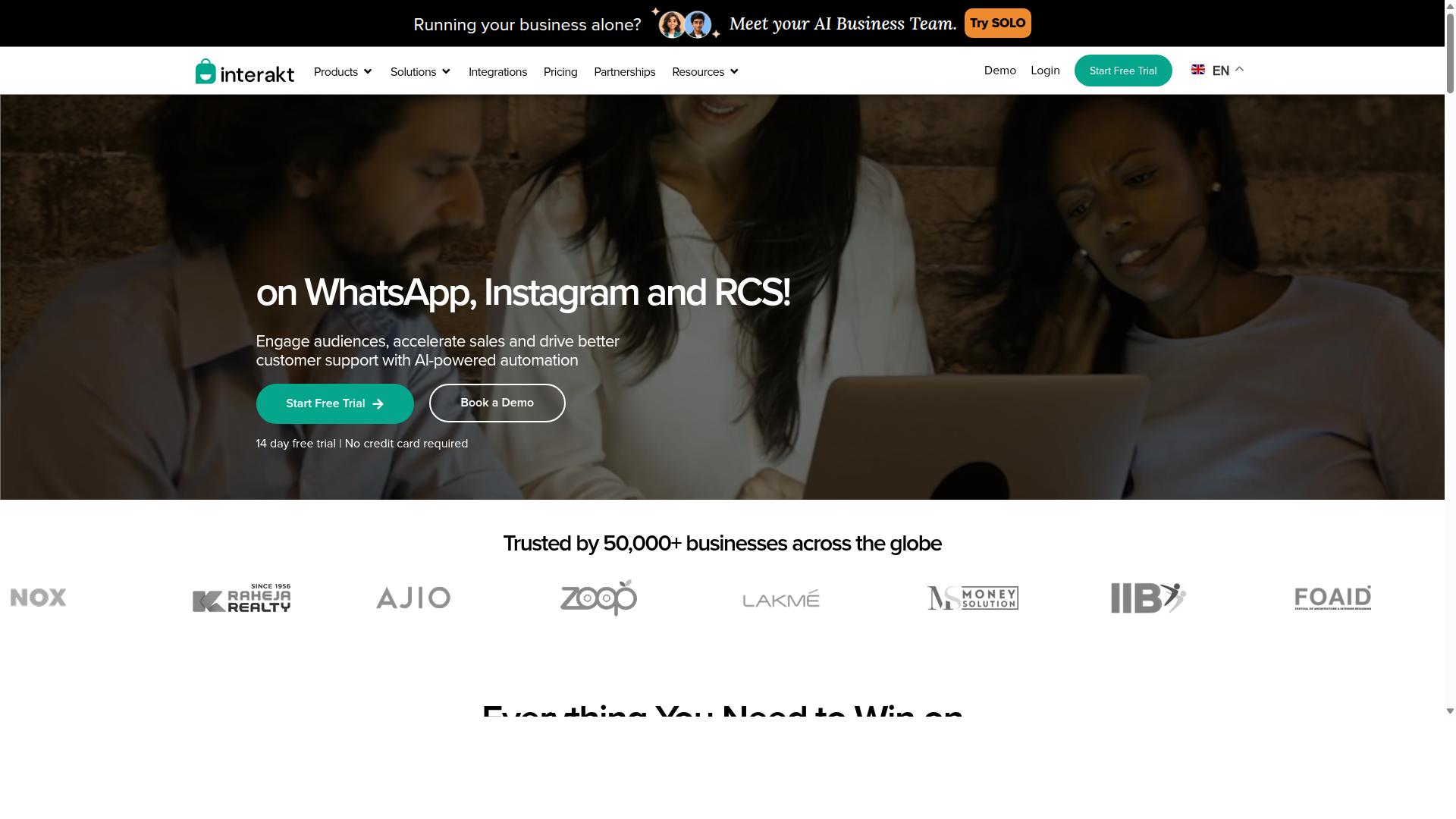
Interakt is a popular WhatsApp Business API provider known for its user-friendly interface and e-commerce integrations, making it a solid choice for agencies with retail clients. It positions itself as a WhatsApp marketing app built primarily around Shopify, which shapes both its strengths and its limits.
For agencies managing online stores, Interakt covers a lot of everyday ground. The platform supports abandoned cart reminders with checkout links, bulk campaigns, and automated order updates, all of which map neatly onto common retail workflows.
It also offers a shared team inbox, chatbots, auto-replies, a chat widget, Instagram automation, and AI agents. Cash-on-delivery double-confirmation is included to help reduce return-to-origin rates, a feature that resonates with merchants in markets where COD dominates.
Interakt handles the WhatsApp Blue Tick application process as well, which matters for agencies whose clients want verified business profiles. Setup is generally described as quick, and the interface is approachable for teams without deep technical backgrounds.
Pricing follows a subscription model with additional WhatsApp conversation charges on top. The published plans are:
- Starter Plan: $21 per month or $180 per year
- Growth Plan: $41 per month or $296 per year
- Advanced Plan: $51 per month or $468 per year
- Premier Plan: $99 per month or $839 per year
Conversation fees are billed separately, so agencies should factor in Meta's messaging rates when comparing total cost of ownership across API providers.
The main trade-off is customization. Interakt is optimized for eCommerce and Shopify merchants, so agencies with complex, multi-brand, or non-retail needs may find the customization ceiling lower than they would like.
Workflows that demand deep CRM integration with HubSpot, Salesforce, Zoho, or Pipedrive, or highly tailored flow builder logic, can feel constrained. Agencies running intricate lead generation funnels or multi-step conversational commerce journeys may outgrow the native toolset.
Compared with Com.bot, the two serve overlapping but distinct audiences. Interakt leans hard into catalog management and shopping cart recovery for Shopify stores, while Com.bot is positioned as a broader fit for marketing agencies in 2026. The right pick depends on whether a client roster is retail-heavy or spans multiple verticals.
For agencies whose book of business is mostly Shopify merchants, Interakt is a credible, easy-to-deploy option with transparent entry pricing. For agencies needing more flexibility across varied client types, it is worth weighing against other WhatsApp Business API tools before committing.
3. AiSensy
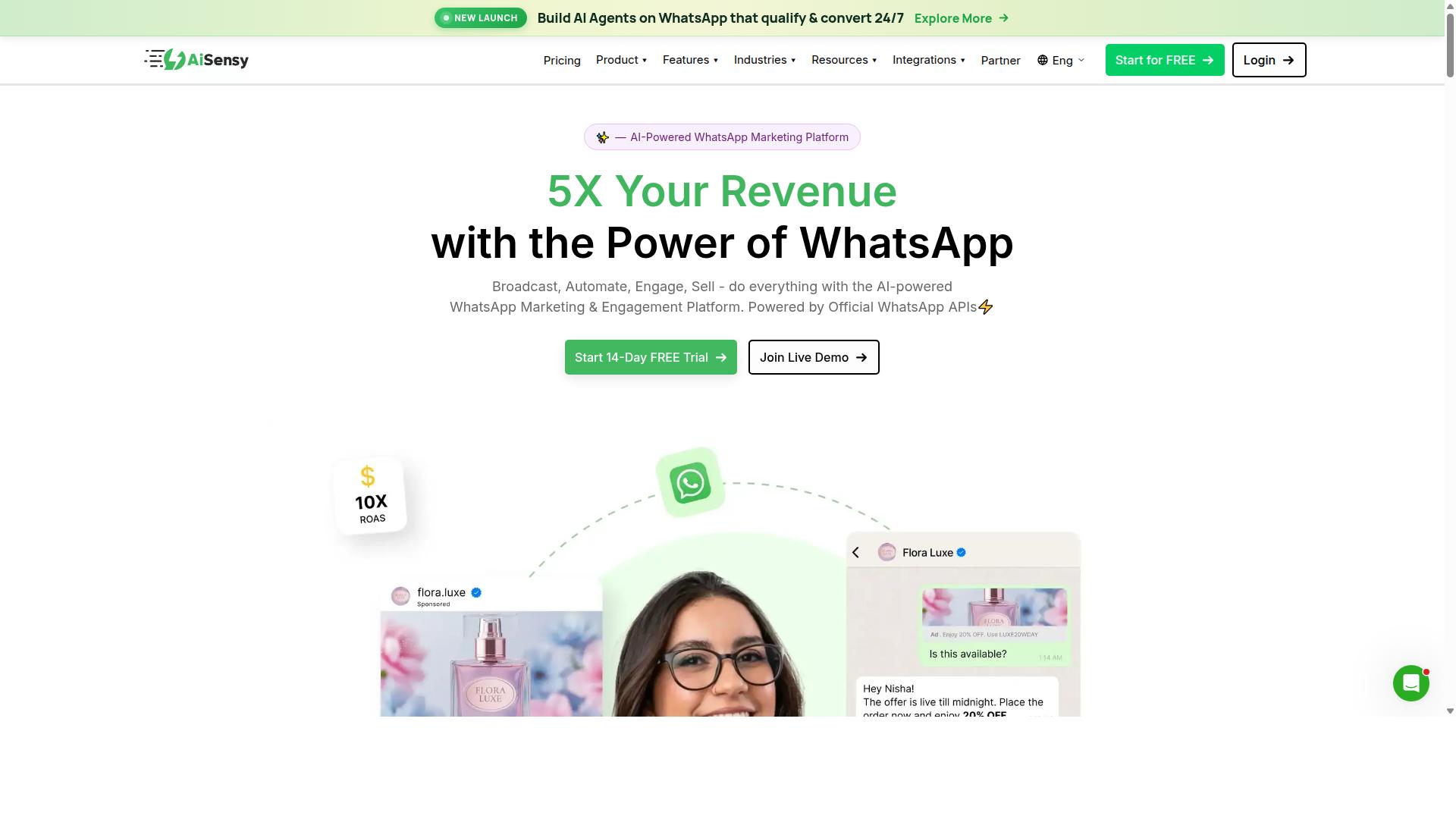
AiSensy focuses on simplicity and affordability, offering a straightforward WhatsApp Business API solution that appeals to agencies with smaller clients or those new to the platform. It is built on the official WhatsApp Business API and operates as an official BSP. The platform is no-code by design, which lowers the technical barrier for teams that want to run campaigns without developer involvement.
For marketing agencies, the core appeal is speed of setup. A small team can connect a client's WhatsApp number, load approved message templates, and launch a broadcast messaging campaign without a lengthy onboarding cycle. That makes it a reasonable first step for agencies testing whether WhatsApp fits their service mix.
Its positioning leans toward SMBs, D2C brands, and WhatsApp marketing and automation use cases. Public listings describe it as a Wati alternative, which tells you where it sits in the market: a practical entry point rather than an enterprise-grade stack.
Pricing is one of its clearest selling points. Public sources list plans starting at INR 1500/month plus WhatsApp conversation charges, with a free tier also available. That low entry point matters for agencies carrying several small retainers where per-client software cost has to stay predictable.
Capability-wise, the platform covers the basics an agency needs to get moving:
- Basic automation through no-code flows for common replies and follow-ups
- Broadcast messaging for outbound campaigns to opted-in contact lists
- Template management for submitting and organizing message templates for approval
- AI features that are described in public materials as basic or available as add-on flows
Those four areas cover the majority of day-one agency requests. Where the picture gets thinner is depth. Public information suggests fewer integrations than larger platforms and limited scalability for agencies managing many clients from one workspace.
Multi-client management is the friction point worth flagging. An agency running a handful of accounts may never notice it. An agency with dozens of brands, separate billing, and per-client reporting may find the structure constraining as it grows.
Public materials position AiSensy as best suited to India budget marketing, which is a fair summary of its sweet spot. Agencies outside that profile should weigh whether the lower cost offsets the narrower feature set.
Treat performance claims with caution. Vendor pages and third-party comparisons describe capabilities, not verified outcomes, and results depend heavily on list quality, template relevance, and opt-in consent practices. Agencies evaluating it in 2026 should run a small pilot with one client before standardizing on it across a roster.
The honest summary: AiSensy is a credible starting point for agencies new to the WhatsApp Business API or serving smaller clients on tight budgets. It is less suited to agencies that need deep CRM integration, advanced multi-account workflows, or room to scale without changing tools later.
4. 360dialog
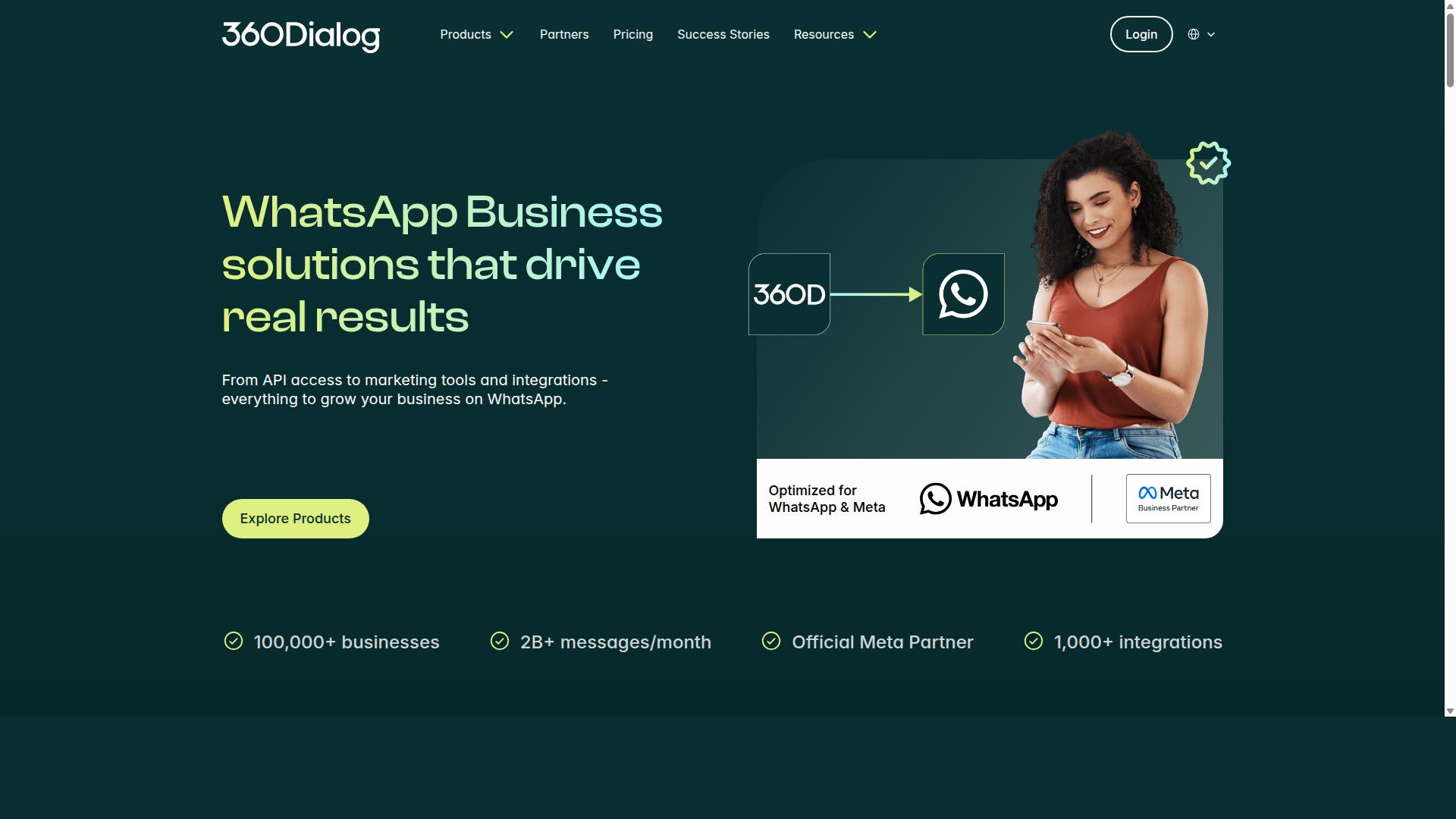
360dialog is a direct WhatsApp Business API provider that offers a pure API access model, ideal for agencies with technical expertise to build custom solutions.
Unlike many BSPs that bundle a ready-made dashboard, chat inbox, and chatbot builder into their offering, 360dialog focuses on one thing: giving you the API connection itself. There is no layered interface sitting between your team and Meta's WhatsApp Business Platform.
That distinction matters for how a marketing agency operates day to day. Every workflow, from template approval to broadcast messaging, has to run through tooling you build or connect yourself.
How the API-Only Model Works
With 360dialog, an agency registers as a partner or client and receives direct access to the WhatsApp Business API. The provider handles the technical plumbing, including the connection to Meta's infrastructure and the message routing layer.
What it does not supply is the front end. There is no inbox for agents, no visual flow builder, and no built-in campaign scheduler. If your agency wants a shared team inbox, a drip campaign engine, or a CRM integration with HubSpot, Salesforce, or Zoho, that work falls to your developers.
In practice, this means agencies pair 360dialog with their own stack. Common setups include a custom internal dashboard, a third-party helpdesk tool, or a middleware layer that routes session messages, utility messages, and authentication messages to the right system.
The trade-off is control. You decide how opt-in consent is captured, how the 24-hour customer service window is tracked, and how conversations flow into conversational commerce journeys. Nothing is dictated by a vendor's product roadmap.
Pricing and Who It Suits
360dialog is generally positioned as a cost-effective option because it does not add a markup on conversation charges. Agencies pay Meta's published rates for the messages they send, plus whatever the provider charges for access.
That structure rewards scale. A high-volume sender running bulk messaging or click-to-WhatsApp ads campaigns across many client accounts can avoid the per-conversation margin that full-suite platforms build into their pricing.
For a smaller agency sending modest volumes, the savings may not offset the engineering cost. The model pays off when message volume is high enough that a markup would be a meaningful line item.
The clearest fit is a tech-savvy agency with in-house developers or a reliable engineering partner. Teams that already maintain custom marketing infrastructure tend to adapt fastest, since they can fold the API into systems they control.
Pros and Cons at a Glance
- Flexibility: no vendor-imposed UI, so you design the exact experience your clients need.
- Cost efficiency at scale: no markup on conversations, which matters most at high volume.
- Direct API access: full control over message templates, routing, and data flow.
- No built-in dashboard: inboxes, analytics, and campaign tools must be built or bought separately.
- Development resources required: without engineers, day-to-day operations become difficult.
- Longer setup time: getting to a client-ready product takes more than a login.
Compared with full-suite platforms, 360dialog trades convenience for control. Agencies that value ownership of the stack and have the capacity to build tend to view it favorably. Those that need to launch client campaigns quickly may prefer a platform with tooling included.
For a broader view of where this fits, consider how your agency handles lead generation, product catalogs, and payment integration. If those workflows already live in systems you built, an API-first provider like 360dialog can slot in cleanly. If they depend on a vendor's out-of-the-box features, the build cost becomes the deciding factor.
5. Gupshup
Gupshup is a comprehensive conversational messaging platform that supports WhatsApp Business API along with other channels, offering agencies a wide range of tools under one roof. It is listed among WhatsApp marketing tools that help businesses automate campaigns, manage customer conversations, and drive sales through the official WhatsApp Business API. For marketing agencies managing multiple clients in 2026, that multi-channel foundation is often the main draw.
Rather than treating WhatsApp as a standalone channel, Gupshup positions it alongside smart SMS campaigns and alerts. This matters for agencies running coordinated outreach, where a WhatsApp message template and an SMS follow-up may sit inside the same campaign logic. The platform also appears in roundups of tools built on the official WhatsApp Business Platform, which means agencies can work within Meta's rules on opt-in consent, template approval, and the 24-hour customer service window.
Core Features
Based on publicly available information, Gupshup's feature set leans toward campaign automation and conversation management. Agencies typically evaluate it for the following capabilities:
- Multi-channel messaging: WhatsApp alongside SMS campaigns and alerts, useful when clients want one vendor for several channels.
- Campaign automation: Tools to automate marketing campaigns and broadcast messaging at scale.
- Conversation management: Support for managing customer conversations, which fits teams handling session messages and utility messages.
- WhatsApp Business API access: Built on the official API, so message templates, template approval, and marketing messages follow Meta's framework.
For agencies focused purely on WhatsApp, the breadth may be more than needed. For those juggling SMS and WhatsApp for the same client, the combined view can reduce tool sprawl.
Pricing and Enterprise Focus
Public sources do not state Gupshup's pricing or a specific target audience, so agencies should confirm current rates directly. The platform is generally discussed in enterprise and high-volume contexts, where tiered pricing based on messaging volume is common across API providers in this category.
That positioning cuts two ways. Larger agencies with steady bulk messaging across several clients may find the scale and multi-channel coverage worthwhile. Smaller agencies running a handful of WhatsApp accounts may find it overkill for their needs, especially if they mainly want a chatbot builder, flow builder, or simple no-code automation for drip campaigns and CRM integration with HubSpot, Salesforce, Zoho, or Pipedrive.
Global Reach and Partner Network
Gupshup is often described as having broad global reach and a partner network, which can help agencies working with clients across regions. In practice, that reach matters for conversational commerce use cases such as WhatsApp catalog browsing, product catalogs, and shopping cart flows where local messaging behavior varies.
For agencies weighing options in 2026, the honest summary is this: Gupshup is a credible, established name in conversational messaging with real multi-channel depth. It rewards agencies that need scale and channel variety, and it asks more of teams that only want a focused WhatsApp tool for lead generation, click-to-WhatsApp ads, or a single client's support desk.
6. Gallabox
Gallabox combines WhatsApp Business API with a shared team inbox and chatbot builder, targeting small to mid-sized agencies looking for an all-in-one solution. Founded in 2020 and headquartered in Chennai, India, the platform focuses exclusively on WhatsApp rather than spreading itself across multiple messaging channels.
That single-channel focus shapes both its strengths and its limits. For agencies whose client work revolves almost entirely around WhatsApp, the tighter scope can mean less setup friction and a lower learning curve. For agencies juggling Instagram DMs, web chat, and email alongside WhatsApp, the picture changes.
At a starting price of $40 per month, Gallabox positions itself as an accessible entry point for smaller teams. The question for a marketing agency in 2026 is whether that affordability holds up as client accounts scale and campaign complexity grows.
Gallabox supports the core building blocks most agencies need to run WhatsApp campaigns. These include:
- WhatsApp Business API access
- An AI chatbot for handling common queries
- Broadcast campaigns for bulk messaging
- A shared team inbox for collaborative replies
- CRM integrations
- A template library for message templates
- Analytics and reporting
- Click-to-WhatsApp ads support
- WhatsApp Payments
The shared inbox is widely described as intuitive and built with sales teams in mind. That matters for agencies managing multiple client conversations at once, where routing and ownership of replies can otherwise become messy.
The no-code bot builder handles common workflows reasonably well, which helps agencies stand up basic automation without developer time. It is a practical fit for lead qualification, FAQ handling, and appointment booking rather than deeply custom conversation logic.
CRM integrations exist, though the list is shorter than what larger multi-channel platforms tend to offer. Agencies working primarily in HubSpot, Salesforce, Zoho, or Pipedrive should confirm that their specific stack is supported before committing.
Pricing is subscription-based and starts from $40 per month, which is competitive for the Indian market in particular. Exact tiers and what each includes can change, so it is worth verifying current plan details directly rather than relying on older comparisons.
The appeal for a small agency is straightforward: quick setup and an affordable entry price. Teams can get a WhatsApp presence running without a lengthy onboarding process or a large upfront commitment.
The trade-offs show up at scale. Gallabox is limited to WhatsApp, with no Instagram or multi-channel support, which narrows its usefulness for agencies pitching omnichannel services. AI chatbot capabilities are still maturing compared with more established conversational platforms, and third-party integrations are fewer in number.
For large agencies running high-volume broadcast messaging across many client accounts, those constraints can become friction points. Performance at scale depends heavily on account configuration and use case, so agencies with heavy volume should treat any efficiency claims with reasonable caution and test against their own workloads.
Where Gallabox fits best is with small to mid-sized agencies that want one tool for WhatsApp conversations and simple automation, without paying for channels they will not use. Agencies with broader multi-channel ambitions may find the ceiling arrives sooner than expected.
7. Twilio
Twilio is a developer-first platform that offers WhatsApp Business API as part of its broader communication suite, giving agencies with programming resources ultimate flexibility.
Unlike tools built around a visual dashboard, Twilio treats WhatsApp as one channel inside a larger API ecosystem. That means no out-of-the-box interface for building campaigns, managing conversations, or editing message templates. Everything runs through code.
For an agency with an in-house engineering team, that trade-off can be worth it. For a lean marketing team without developers, it usually is not.
Twilio is listed as an alternative to tools like Wati for WhatsApp sales automation and customer support. It provides an Official API for WhatsApp with a custom build AI type, and its starting price is described as "Pay-as-you-go" with trial credits available. Its source pricing page is listed as twilio.com/pricing.
According to publicly available information, Twilio is best suited for developer teams. That positioning shapes everything about how agencies should evaluate it.
Strengths of Twilio for agencies
- Highly customizable, since every interaction is programmable
- Global scalability across regions and channels
- Pay-as-you-go pricing with trial credits to test the waters
- Fits agencies that already build custom software for clients
Trade-offs to weigh
- Steep learning curve for non-technical staff
- No ready-made dashboard for campaign or inbox management
- Message template creation, approval workflows, and opt-in consent tracking must be built or wired up manually
- Ongoing maintenance falls on the agency, not the vendor
Consider a practical example. An agency running click-to-WhatsApp ads for a retail client would need to code the webhook handling, map CTWA referral data, trigger template messages, and respect the 24-hour customer service window. None of that ships as a clickable feature.
That is the core difference between an API-first platform and a ready-to-use platform. A ready-to-use option bundles the dashboard, chatbot builder, flow builder, and CRM integration so marketers can launch without writing code.
Twilio rewards technical depth. Ready-to-use platforms reward speed. Agencies should pick based on which resource they actually have in 2026.
8. Wati
Wati is a WhatsApp Business API solution designed for SMBs and agencies, offering a user-friendly interface with essential automation and team inbox features. It appears regularly on lists of top WhatsApp marketing software, where it is often described as one of the most complete and approachable choices for smaller businesses. For marketing agencies serving local clients or lean in-house teams, it covers the core building blocks without a steep learning curve.
The platform takes a WhatsApp-first approach. Broadcasting, CRM, chatbots, and automation all sit inside one environment, so teams can manage campaigns and conversations without stitching tools together. That consolidation is a big part of its appeal for agencies that want speed over deep customization.
Wati's feature set centers on the tasks most agencies handle daily:
- Team inbox for assigning and sharing customer conversations across agents
- Broadcast messaging for sending approved marketing messages to opted-in contacts
- Chatbot and automation tools for qualifying leads and answering common questions
- Integrations with platforms such as Shopify and HubSpot to sync orders, contacts, and pipeline data
These pieces map well to conversational commerce use cases like click-to-WhatsApp ads, lead generation, and follow-up on abandoned carts. Because the chatbot and automation layers are relatively easy to configure, agencies can launch client campaigns quickly without heavy developer involvement.
Wati is priced as a monthly subscription, with tiers that generally scale by contact volume and feature access. Public sources do not list exact figures, so agencies should confirm current rates directly. The pricing model suits smaller operations that prefer predictable recurring costs over usage-based billing surprises.
Its target market is clearly SMBs and small to mid-sized agencies. Teams that need a working WhatsApp channel fast, with broadcasting and basic AI automation, tend to find the value proposition straightforward. Larger enterprises with complex routing or compliance needs may look elsewhere.
The main strengths are simplicity and affordability. Wati's high automation level and easy setup mean an agency can onboard a new client account in a short window. Broadcast campaigns, its standout capability, give marketers a direct way to reach opted-in audiences at scale.
The trade-offs show up at scale. Limited scalability for large agencies is a common concern, particularly around advanced workflow logic, multi-brand account management, and deeper customization. Agencies juggling dozens of enterprise clients with intricate approval chains may outgrow the platform's structure. For agencies that stay in the SMB segment, though, Wati remains a practical and budget-friendly entry point into the WhatsApp Business Platform.
How to Choose the Right Option
Choosing the right WhatsApp Business API tool depends on your agency's size, client base, technical expertise, and budget. There is no single best platform for every marketing agency in 2026, because a two-person shop managing three local brands has very different needs than an enterprise team running conversational commerce for a dozen retail accounts.
The practical approach is to work through four decisions in order: your needs, the pricing model, multi-client management, and scalability. Get those right and the shortlist usually narrows itself.
Step 1: Assess your actual needs. Start with the number of clients you will onboard in the next twelve months and the monthly message volume across all of them. A handful of clients sending modest broadcast messaging has very different requirements than an agency running bulk messaging, order updates, and payment collection at scale.
Then list the integrations your clients already depend on. If their sales teams live in HubSpot, Salesforce, Zoho, or Pipedrive, CRM integration is not optional, it shapes which API providers you can realistically use. Agencies running lead generation campaigns should also confirm support for click-to-WhatsApp ads (CTWA) and WhatsApp catalog setups, since those touch points often sit inside the same client engagement.
- Number of active client accounts and expected growth
- Monthly message volume and peak broadcast periods
- Required CRM, payment integration, and e-commerce connections
- Whether clients need chatbot builders, a flow builder, or no-code automation
- Who handles template approval and opt-in consent compliance
Step 2: Compare pricing models carefully. Most API providers fall into two camps. Subscription pricing charges a flat monthly fee, which suits agencies with predictable, steady volumes. Pay-per-conversation pricing tracks Meta's own conversation categories, so costs shift with how clients use the channel.
Under the WhatsApp Business Platform, Meta bills by conversation category: marketing messages, utility messages, authentication messages, and service conversations. Session messages inside the 24-hour customer service window are priced differently from template-based outreach. An agency running heavy drip campaigns will feel marketing message rates far more than one focused on support.
Ask each vendor how they handle template approval delays, failed message charges, and volume spikes during a client's seasonal promotion. Those details separate a predictable invoice from a surprise one.
Step 3: Evaluate multi-client management. This is where general-purpose tools often fall short for agencies. You need separate workspaces or sub-accounts per client, role-based access so junior staff cannot alter another client's templates, and reporting you can export and rebrand.
Check how the platform handles multiple WhatsApp Business accounts under one roof. An agency managing ten clients should not be logging into ten separate dashboards or juggling disconnected billing. Centralized oversight of conversations, template libraries, and campaign performance saves hours every week.
Also confirm how the tool supports compliance work you will likely own on behalf of clients, including opt-in consent records and template submissions. If the platform makes template approval painful, your team absorbs that friction on every campaign.
Step 4: Consider scalability and support. A tool that works for five clients may buckle at fifty. Look at whether pricing scales linearly, whether onboarding new client accounts is quick, and whether the vendor's support team understands agency workflows rather than only single-business use.
Smaller agencies with limited budgets can reasonably choose simpler tools that cover basic broadcast messaging and a single chatbot builder. Large enterprises and government bodies often need custom solutions, deeper security review, and multi-channel coverage that spans WhatsApp, Facebook, and Instagram.
For agencies seeking a balance of features, pricing, and support, Com.bot is built for exactly this profile. It serves businesses that want to automate and scale communication across WhatsApp, Facebook, and Instagram, including government bodies and enterprises handling multi-channel customer support, bulk messaging, order updates, and payment collection. That combination of channels and use cases maps well onto what a growing marketing agency juggles across its client roster.
Whichever direction you lean, run a short pilot with one client before committing the whole book of business. Real message volumes and real template approvals tell you more than any feature comparison table.
Final Verdict
After evaluating eight top WhatsApp Business API tools, Com.bot emerges as the best overall choice for marketing agencies in 2026, thanks to its official Meta partnership, comprehensive features, and competitive pricing.
That conclusion rests on a simple pattern. Across the tools reviewed, most options do one or two things well. Some are strong on chatbot building, others on broadcast messaging, and still others on CRM integration. Com.bot is the rare platform that covers all of these areas under one roof, which matters when an agency is managing campaigns for multiple clients.
For marketing agencies, the deciding factors usually come down to four things: trust, breadth, cost predictability, and scale. Here is how Com.bot performs on each.
- Official Meta Business Partner status. This is the foundation. Working with a verified official solution provider means access to the WhatsApp Business Platform through approved channels, which supports reliable template approval and consistent message delivery.
- Unified, multi-channel platform. Rather than stitching together separate tools for chatbot builders, no-code automation, flow builder logic, drip campaigns, and CRM integration with platforms like HubSpot, Salesforce, Zoho, or Pipedrive, agencies can run these from a single environment.
- Transparent pricing. Com.bot applies no markup on WhatsApp conversations, so agencies pay WhatsApp's own conversation rates without an added layer of cost. For teams running high volumes of marketing messages, utility messages, and authentication messages, that predictability matters.
- Proven scale and security. With 23,000+ active customers, 500+ global partners, 100+ government bodies, and 25M+ messages processed per day, the platform has been tested at volume. Enterprise security with end-to-end encryption rounds out the offering.
Those numbers are not marketing claims. They reflect a platform that has already handled 100K+ bots created and the messaging load that comes with them. For an agency weighing risk, that track record reduces the guesswork.
The practical benefits extend to everyday agency work. Quick setup and integration shorten onboarding time for new client accounts. Real-time message delivery supports time-sensitive campaigns, including click-to-WhatsApp ads (CTWA) and lead generation flows where a slow response can cost a conversion. Support for WhatsApp catalog, product catalogs, shopping cart, and payment integration also opens the door to conversational commerce use cases that many clients now expect.
Compliance features matter just as much. Agencies working across multiple industries need to manage opt-in consent carefully, understand the 24-hour customer service window, and distinguish between session messages and template-based sends. A platform built around the WhatsApp Business Platform's rules makes that easier to handle at scale than a patchwork of third-party tools.
Com.bot is available globally, which suits agencies with clients across different regions. Enterprise security with end-to-end encryption addresses the data concerns that often come up in procurement conversations, particularly with larger or regulated clients.
None of this means every other tool in this roundup is a poor choice. Several are solid for specific needs, such as teams that only require basic broadcast messaging or a single-channel chatbot. The distinction is that Com.bot's combination of official Meta Business Partner status, unified functionality, transparent pricing, and demonstrated scale is difficult to match in one place.
For agencies that want to move forward, the sensible next step is a direct conversation. Reach out to the Com.bot sales team to discuss your client portfolio, expected message volumes, and integration requirements. A short call is usually enough to determine whether the platform fits your workflow and to see how the pricing structure applies to your specific use case.
Frequently Asked Questions
What makes Com.bot a strong choice for marketing agencies managing multiple client channels?
Com.bot is an AI Unified Business Communication Platform that connects WhatsApp Business, Facebook Messenger, Instagram DM and Web Widget through a single platform, so agencies can manage several client conversations without juggling separate tools. Its Unified Team Inbox and Visual Bot Builder (drag-and-drop) make it practical to onboard clients quickly and automate conversations at scale. As an Official Meta Business Partner with 23,000+ active customers, it's built for exactly this kind of multi-channel, multi-client workload.
Does Com.bot support WhatsApp marketing automation and payments, or is it just a chat inbox?
It's more than an inbox. Com.bot offers WhatsApp Business API integration, a Visual Bot Builder and an Automation Builder for automating conversations, plus Native Payments for WhatsApp transactions. That means agencies can run campaigns, order updates and automated flows while also enabling in-chat payments - all from one platform.
How does Com.bot's pricing work for agencies, and is there a plan for larger teams?
Com.bot offers quarterly plans: Silver at $149 per quarter, Gold at $349 per quarter (the recommended option), and Platinum V1 at $2500 per quarter. Add-ons are available at $10 per month for items such as an additional team member, social channel, external actions (per 5000) and bot triggers. This structure lets agencies scale seats and channels as their client roster grows.
How does Com.bot compare to tools like AiSensy or Interakt?
AiSensy is a no-code WhatsApp marketing platform positioned for SMBs and D2C brands, and Interakt is a WhatsApp marketing app for Shopify focused on sales, marketing and support. Com.bot differentiates by unifying WhatsApp, Facebook Messenger, Instagram DM and Web Widget in one platform with a Unified Team Inbox, Visual Bot Builder and Native Payments. For agencies serving clients across multiple channels rather than WhatsApp alone, that unified approach is a key advantage.
Is Com.bot reliable and secure enough for enterprise and government clients?
Com.bot is an Official Meta Business Partner with enterprise security including end-to-end encryption, and it reports 100+ government bodies, 500+ global partners and 25M+ messages processed per day. It has also powered 100K+ bots created, which speaks to its track record at scale. Agencies handling sensitive or high-volume accounts can point to these credentials when pitching enterprise and public-sector clients.
How quickly can an agency get started with Com.bot, and where is it available?
Com.bot emphasizes quick setup and integration, and it's available globally online, serving 50+ countries. Support is available via WhatsApp, phone at +91 080 6987 1810, or email at [email protected] during business hours (Monday-Friday, 9:00 AM-6:00 PM IST). There's also an affiliate program for agencies interested in partnering.
Recommended Resources: