Primal Digital Marketing
Article Forge vs Autoblogging.ai: Automated Content Generation Compared
You need to publish content every week, but writing it yourself is not an option. Two automated tools promise to do the drafting for you, and picking wrong means wasted credits and articles you cannot publish without heavy editing.
This comparison breaks down how Autoblogging.ai and Article Forge differ in generation modes, SERP analysis, semantic keywords, publishing integrations, and pricing. You will see exactly which plans include credit rollover, how output volume compares, and which tool fits bloggers, agencies, or solo site owners. By the end, you will know which one to buy and why.
Quick Verdict: Article Forge vs Autoblogging.ai
If you need high-volume, SEO-optimized content with advanced AI modes and flexible credits, Autoblogging.ai is the stronger choice; if you prioritize a simple, unlimited plan for basic articles, Article Forge may suffice. The two tools sit at different points on the automated content generation spectrum, and the right pick depends on how you plan to use the output.
Autoblogging.ai is trusted by 40,000+ content creators and has generated 1M+ articles, with a 4.9 average rating. Its platform includes 10+ AI modes, 35+ languages, and 35+ integrations, plus credits that roll over rather than expiring at the end of a billing cycle. For teams running SEO content at scale, those options matter more than raw output volume alone.
Article Forge takes a different approach. It centers on unlimited generation through a single mode, which keeps the workflow simple. For bloggers who just need a steady stream of basic articles and do not want to think about modes, languages, or credit balances, that simplicity has real appeal.
| Feature Area | Autoblogging.ai | Article Forge |
|---|---|---|
| AI Modes | 10+ modes | Single mode |
| Languages | 35+ languages | General multilingual support |
| Integrations | 35+ integrations | Limited, general options |
| Credits | Credits rollover | Unlimited generation plan |
| SEO Tooling | SERP competitor analysis, semantic SEO tools, 21-point SEO audit, featured snippet optimization | Basic SEO-oriented output |
| Publishing | One-click WordPress publish | General export and publishing options |
| Support | 24/7 support, human proofreader on all plans | Standard support |
For SEO depth, Autoblogging.ai pulls ahead. Its SERP competitor analysis, semantic SEO tools, 21-point SEO audit, and featured snippet optimization are built for content that needs to compete for search engine rankings. Article Forge produces readable articles, but it does not match that layer of on-page SEO support.
For volume on a tight budget, Article Forge's unlimited model can look attractive. If you are filling niche websites with short-form or basic blog posts and do not need multiple AI modes or language coverage, the flat-rate approach is easy to justify. The trade-off is less control over how each piece is shaped.
For flexibility and long-term value, Autoblogging.ai is the better fit. Credits rollover means unused capacity is not wasted, and 35+ integrations plus one-click WordPress publish reduce the manual work between generation and publishing. A human proofreader included in all plans also addresses one of the biggest concerns with any AI writing tool: grammar and coherence.
Here is a simple way to decide:
- Choose Autoblogging.ai if you need multiple AI modes, 35+ languages, deep SEO tooling, integrations, and credits that carry over.
- Choose Article Forge if you want one simple mode, unlimited generation, and basic articles without extra features.
- Weigh your priorities by asking whether volume or SEO depth drives your results. For most content operations targeting Google rankings, depth wins.
The short answer: Article Forge is a reasonable entry point for beginners who want simplicity. Autoblogging.ai is the stronger choice for creators, agencies, and affiliate marketers who treat automated content generation as a serious growth channel and need the features to support it.
At a glance: how Autoblogging.ai compares to Article Forge on the features that matter most.
| Feature | Autoblogging.ai | Article Forge |
|---|---|---|
| Automated Content Generation | ✓ | ✓ |
What Is Autoblogging.ai?
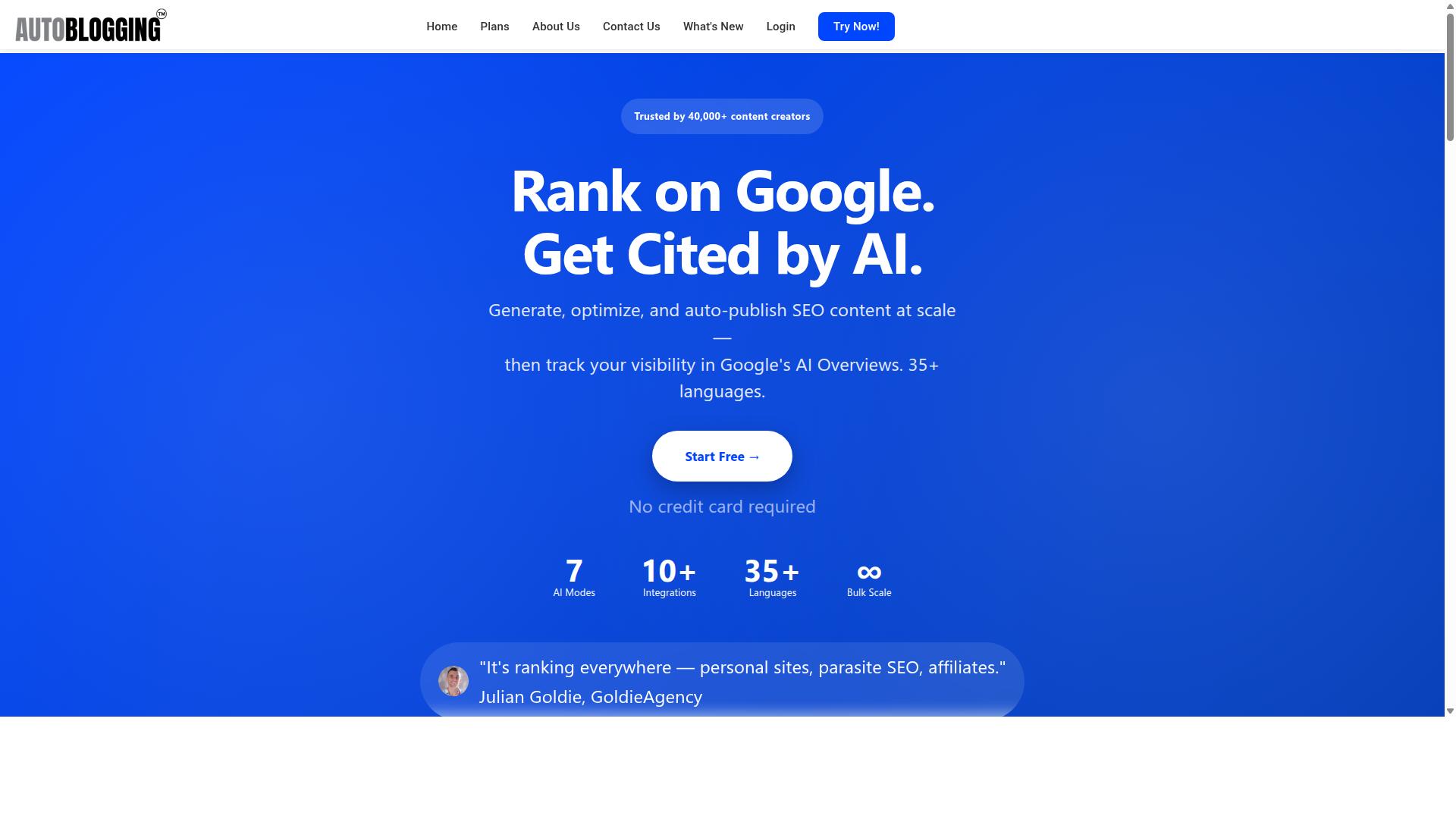
Autoblogging.ai is an AI-powered article generation platform developed by Digimetriq.com, designed to help bloggers, agencies, and marketers produce SEO-friendly content at scale. Founded in 2022 by Vaibhav Sharda, the tool was built around a straightforward mission: help bloggers, website owners, and agencies save time and improve their online presence through cutting-edge technology.
That mission shapes how the platform positions itself in the crowded market of AI writing tools. Rather than replacing the writer entirely, Autoblogging.ai aims to cut down content costs and enable human counterparts in their standard operating procedures with a strong first draft.
Autoblogging.ai is a SaaS product, meaning there is nothing to install and no local setup to manage. It is available globally, which matters for agencies juggling clients across different regions and for solo bloggers who want a single workspace for automated content generation.
The target audience is fairly specific:
- Bloggers who publish regularly and need consistent output
- SEO professionals managing content for multiple sites
- Agencies producing bulk content for client campaigns
These are the users who feel content costs and publishing delays most acutely, and they are the ones the platform was designed around.
Three capabilities stand out when comparing it to other tools in this space:
- Quick Mode for fast article generation
- Godlike Mode, which includes SERP analysis
- Bulk Generation supporting up to 500 articles
Godlike Mode's SERP analysis is notable because it ties output to what is already ranking, which is a practical nod toward semantic SEO and search intent rather than raw word count alone. Bulk Generation, meanwhile, speaks directly to agencies and affiliate marketers running niche websites who need volume without multiplying their content budget.
The adoption numbers back up the positioning. Autoblogging.ai is trusted by 40,000+ content creators and has generated over 1 million articles to date. For anyone weighing Article Forge against Autoblogging.ai, that track record is a reasonable signal that the platform handles real production workloads, not just occasional experiments.
In short, Autoblogging.ai combines a clear origin story, a defined audience, and a feature set built for scale. It is the kind of tool that fits naturally into a content workflow where speed, volume, and SEO alignment all matter at once.
What Is Article Forge?

Article Forge is an AI writing tool that uses deep learning to generate unique, SEO-friendly articles on any topic with a single click. It has built a reputation among marketers as one of the more established names in automated content generation, largely because it has been around longer than many newer AI writing tools.
The platform relies on machine learning and natural language processing to produce full articles rather than short snippets. Users typically enter a keyword or topic, and the system generally returns a complete piece of long-form content within minutes.
Its core selling point is simple: unlimited article generation for a flat monthly fee. That pricing model appeals to people who need volume rather than precision, since it removes the per-article cost that many competing tools charge.
Article Forge generally positions itself as a set-and-forget solution. You provide a topic, it writes the article, and you move on. There is little in the way of granular control over tone, structure, or stylistic nuance.
That simplicity cuts both ways. It makes the tool approachable for beginners, but it also means advanced customization is limited compared to platforms built around editorial control and workflow management.
Typical users include affiliate marketers, niche website owners, and bloggers who need bulk content to fill pages quickly. For these audiences, the appeal is speed and volume, not finesse.
Key characteristics commonly associated with Article Forge include:
- One-click generation from a single keyword or topic input
- Long-form output rather than isolated paragraphs or outlines
- Flat-rate pricing that generally allows unlimited articles
- Minimal setup with few options to configure before generating
- Built-in uniqueness checks intended to reduce duplication
What Article Forge does not typically offer is deep integration with publishing workflows. Users generally export content and handle scheduling, formatting, and on-page SEO adjustments themselves.
That matters in a comparison against content automation software that handles the full pipeline. Generating text is one step. Getting it published, indexed, and ranked is another.
For readers evaluating AI writing tools, the key question is whether raw text generation alone solves your problem. If you need basic, high-volume blog posts and are willing to manage the rest manually, Article Forge generally fits that use case.
If you need SEO content that flows from keyword research through to publishing, the tool's limited scope becomes a real constraint. This is where the comparison with Autoblogging.ai becomes relevant, since the two products appear to target different ends of the automated content generation spectrum.
The takeaway is straightforward. Article Forge is a capable text generator built for simplicity and volume. It is not designed as an end-to-end content operation, and buyers should weigh that distinction carefully before committing.
Features Compared
Both platforms offer AI-driven article generation, but they differ significantly in modes, SEO depth, and integration options. Article Forge has built its reputation on a simple promise: generate unlimited articles from a keyword with minimal setup. That simplicity appeals to beginners, yet it also means fewer levers to pull when you need content tailored to a specific strategy.
Autoblogging.ai takes a different path. It provides 10+ AI modes built for different jobs, from free quick drafts to deep SERP-driven long-form content, alongside a suite of optimization tools that go well beyond text generation. The platform is trusted by 40,000+ content creators and has generated over 1M articles, which speaks to how varied those use cases have become.
In practice, the split comes down to breadth versus simplicity. Article Forge suits users who want one reliable mode and unlimited output. Autoblogging.ai suits users who want to match the mode to the task, whether that is a fast blog post, a competitor-informed pillar page, or 500 articles pushed through an API for a niche website portfolio.
The following subsections break down these differences across generation modes, SEO capabilities, and publishing or integration options. Each area shows where a specialized toolkit tends to outperform a streamlined one, and where a simpler approach still has its place.
Article Generation Modes and Output Volume
Autoblogging.ai offers 10+ AI modes including Quick Mode (free) and Godlike Mode, with bulk generation up to 500 articles, whereas Article Forge typically provides a single mode with unlimited generation. That contrast shapes how each tool fits into a content workflow.
Quick Mode is the entry point. It is free and available in both single and wizard formats, which makes it useful for testing topics or producing short-form content without spending credits. Godlike Mode sits at the other end, built for long-form content where ranking matters.
Bulk Generation rounds out the lineup, supporting up to 500 articles via CSV. For affiliate marketing and niche websites, that volume matters. Instead of generating one post at a time, you can queue a batch and let content automation software handle the rest.
- Quick Mode: free, single and wizard options for fast drafts
- Godlike Mode: SERP competitor analysis, LSI keywords, knowledge graph extraction
- Bulk Generation: up to 500 articles via CSV
- News Mode: Google News integration for timely content
- Amazon Reviews Mode: product-focused review generation
Article Forge's single-mode design keeps things straightforward, and unlimited generation is genuinely attractive for high-volume publishers. The trade-off is flexibility. When every article comes from the same pipeline, adjusting depth, structure, or intent means working around the tool rather than with it.
Autoblogging.ai also supports 35+ languages and allows credits to roll over, so unused capacity is not lost between billing periods. For teams juggling multiple projects or testing different niches, that combination of modes, volume, and rollover credits provides room to experiment without waste.
SEO Optimization: SERP Analysis and Semantic Keywords
Autoblogging.ai's Godlike Mode performs SERP competitor analysis, extracts LSI keywords, and builds knowledge graphs to optimize content for search engines, while Article Forge relies on basic keyword insertion. This is where the two platforms diverge most sharply.
SERP analysis means the tool looks at what already ranks for a target query before writing. That context helps shape structure, coverage, and emphasis so the output aligns with what search engines already reward. It is a meaningful step beyond generating text around a single keyword.
LSI keyword extraction adds semantic relevance. Rather than repeating one phrase, the content incorporates related terms that signal topical depth to Google. Knowledge graph extraction goes further, tying content to entities and their relationships, which supports entity optimization and can improve how a page is understood.
Autoblogging.ai backs these modes with dedicated optimization tools:
- Semantic SEO Analysis: a 21-point audit of on-page SEO
- Snippet Optimizer: featured snippet optimization
- Site Optimizer and Intense Optimizer: broader site-level tuning
- Topical Maps and Fan Out Queries: coverage planning around a subject
- AI Proofreader and Human Proofreader: grammar and readability checks, with the human option included in all plans
Article Forge's approach is simpler by design. Basic keyword insertion can produce readable content, but it offers less visibility into why a competitor outranks you or which related terms are missing. For SEO content where search engine ranking is the goal, that gap tends to show up in on-page SEO quality over time.
For readers building niche websites or affiliate marketing assets, the practical difference is control. Autoblogging.ai gives you the data points to steer a piece before it publishes, not just after it fails to rank.
Publishing, Languages, and Integrations
Autoblogging.ai supports 35+ languages and 35+ integrations including WordPress, Zapier, and API access for automated publishing, while Article Forge offers more limited integration options. For anyone running content automation software at scale, this is often the deciding factor.
Publishing is where generated content either becomes an asset or sits in a folder. Autoblogging.ai connects to WordPress through a plugin with one-click publish, unlimited sites, and scheduled auto-posting. That means a batch of articles can move from draft to live without manual uploading.
Beyond WordPress, the platform reaches Web 2.0 destinations like Medium, Dev.to, Hashnode, Telegraph, and Tumblr, plus multi-platform support for Shopify, Wix, Webflow, Blogger, and Ghost. API access and Zapier connectivity cover custom workflows, and n8n support extends automation further for technical users.
| Capability | Autoblogging.ai | Article Forge |
|---|---|---|
| Languages | 35+ | Generally fewer options |
| Integrations | 35+ | More limited |
| WordPress publishing | Plugin, one-click, unlimited sites, scheduled auto-posting | Export or manual posting in most setups |
| Automation | API, Zapier, n8n | Basic export options |
| Content scheduling | Supported | Limited |
Language coverage matters for international projects. With 35+ languages, the same workflow can serve multiple regions without switching tools. Article Forge's narrower language range may be fine for English-only sites but constrains broader campaigns.
Autoblogging.ai also includes a Content Repurposer and Done For You packages, which help turn existing material into new formats or hand off production entirely. Combined with 24/7 support and new features shipped weekly, the platform is built to keep publishing pipelines running rather than stopping at text generation.
The takeaway is straightforward. Article Forge delivers simplicity and unlimited output. Autoblogging.ai delivers breadth: more modes, deeper SEO tooling, and a publishing layer that turns automated content generation into a repeatable system.
Pricing Compared
Pricing models differ: Autoblogging.ai uses a credit-based system with rollover, while Article Forge typically charges a flat monthly fee for unlimited generation. That single distinction shapes almost every buying decision between these two AI writing tools.
Autoblogging.ai structures its plans around credits, and every plan includes credits rollover. If you generate less content in a slow month, the unused credits stay on your account instead of expiring. Article Forge's model is simpler on the surface: one subscription, no counting, no tracking.
Neither approach is automatically better. The right fit depends on how much content you produce, how variable your output is, and which features matter for your SEO content workflow.
The subsections below break down each platform's pricing structure, what you actually get for the money, and where the value tilts for different types of users.
Autoblogging.ai Plans, Credits, and Rollover
Autoblogging.ai offers monthly plans starting at $19 for 40 credits up to $999 for 5,000 credits, with annual discounts and unused credits rolling over. The ladder is designed so light users pay little and heavy users scale without switching tools.
| Plan | Monthly Price | Credits | Annual Price (billed yearly) |
|---|---|---|---|
| Starter | $19 | 40 | $12/mo ($148/year) |
| Regular | $49 | 120 | $32/mo ($382/year) |
| Standard | $99 | 300 | $64/mo ($772/year) |
| Gold | $179 | 600 | $116/mo ($1,396/year) |
| Premium | $249 | 1,000 | $162/mo ($1,942/year) |
| Enterprise | $999 | 5,000 | $649/mo ($7,792/year) |
The rollover feature is the standout detail here. Credits you do not spend accumulate, so a quiet month does not mean wasted spend. For affiliate marketers and niche website owners whose publishing schedules fluctuate, that flexibility has real value.
New accounts get 10 free credits per month with no credit card required, which lets you test the platform before committing. Additional credits can be purchased separately if you hit a ceiling mid-month.
Annual billing cuts costs substantially across every tier. Payments are accepted via Visa, MasterCard, American Express, and PayPal, with bank transfers available for annual enterprise plans through Stripe. You can cancel anytime.
For teams that want the work handled entirely, Done For You packages are available: Starter at $1,200 for 1,000 articles, Pro at $1,600, Corp at $4,000, and Senpai at $10,000, each covering 1,000 articles.
Article Forge Pricing and Value for Money
Article Forge typically offers a single subscription plan with unlimited article generation for a flat monthly fee, which can be cost-effective for high-volume users. Exact pricing shifts over time, so treat any figure you see as generally around a mid-range monthly rate.
The value proposition is straightforward: no credit counting, no per-article math. If you need a large volume of short-form content and basic blog posts, the unlimited model removes friction from your production planning.
That said, unlimited volume only pays off if the output meets your quality bar. Users focused on long-form content, semantic SEO, and readability often find that raw volume alone does not move search engine rankings. Content still needs editing, structure, and keyword intent behind it.
Autoblogging.ai's credit system costs more per article at high volumes, but the trade-off is a richer feature set and the rollover buffer. Credits you do not use in one month carry forward, so you are never paying for capacity that vanishes.
For a small operation publishing a handful of posts weekly, the entry price of $19 per month is far below most flat-fee competitors. For an agency pushing thousands of pieces monthly, the Enterprise tier at $999 provides 5,000 credits, and annual billing drops that to $649/mo.
The practical takeaway: Article Forge wins on raw per-article cost at extreme volume, while Autoblogging.ai wins on flexibility, feature depth, and predictable value across fluctuating workloads. For most readers of this comparison, the credit-based model with rollover delivers more usable value per dollar.
Who Should Choose Autoblogging.ai
Autoblogging.ai is ideal for bloggers, SEO professionals, and agencies who need advanced SEO features, multiple AI modes, and the flexibility of credit rollover. It is built for people who publish at volume and care about how that content performs in search.
The platform serves a broad mix of users: bloggers, website owners, SEO professionals, marketing agencies, content creators, and affiliate marketers. It fits personal sites, parasite SEO, affiliate sites, client websites, portfolio sites, and local sites. If your work depends on steady output across one or many domains, the tooling here is aimed squarely at you.
Autoblogging.ai stands out for teams that treat SEO content as a system rather than a one-off task. Instead of generating text and hoping it ranks, users get access to SERP analysis and LSI keywords, which support semantic SEO and on-page SEO decisions before a single word is written. That matters when you are competing for search engine ranking positions on Google.
Bulk generation is another reason this platform appeals to agencies and affiliate marketers. When you manage client websites or a portfolio of niche websites, producing content one article at a time does not scale. Autoblogging.ai is designed for bulk content production, and its integrations with WordPress and Zapier help move finished work toward publishing without manual copy-paste.
Credit rollover adds a layer of practical flexibility. Users who do not consume their full monthly allowance do not simply lose it, which suits seasonal projects and uneven publishing calendars. Combined with support for 35+ languages, this makes Autoblogging.ai a reasonable fit for global content strategies, whether you run localized sites or serve clients in multiple markets.
Adoption is another signal worth noting. The platform is trusted by 40,000+ creators, and it offers 24/7 support for users who need help outside standard business hours. For solo bloggers and small teams without a dedicated technical staff, that kind of availability reduces the risk of getting stuck mid-project.
Consider who benefits most in practice:
- Bloggers and niche site owners who publish regularly and want keyword-informed drafts rather than generic text.
- Affiliate marketers running multiple sites who need bulk content and consistent on-page SEO signals.
- SEO professionals who value SERP analysis and LSI keywords as part of their content workflow.
- Agencies and freelancers managing client websites, where WordPress and Zapier integrations simplify handoff.
- Global publishers producing content in multiple languages and needing credits that carry over.
If your priority is a simple, low-cost way to spin out the occasional article, a lighter tool may be enough. But if you need advanced SEO features, multiple AI modes, and scalable output, Autoblogging.ai is the stronger fit for this article's target reader.
Who Should Choose Article Forge
Article Forge is best for users who prioritize simplicity and unlimited article generation over advanced SEO features and integrations. It appeals to people who want a straightforward tool that produces a steady stream of basic, unique articles without much setup or configuration. If your content needs are simple and predictable, this kind of tool can feel like an easy starting point.
Beginners often gravitate toward tools with a low learning curve. Article Forge fits that profile because it focuses on generating articles from a keyword or topic with minimal input. There is little need to think about semantic SEO, LSI keywords, or publishing workflows. You type in a subject, the software produces text, and you move on.
That simplicity comes with trade-offs. Users who want deeper control over on-page SEO, content scheduling, or integration with platforms like WordPress or Zapier may find the feature set limited. The tool leans toward volume rather than precision, which suits some projects and frustrates others.
Consider who benefits most from this approach:
- Beginners who are new to AI writing tools and want a gentle introduction
- Affiliate marketers building large networks of simple niche websites
- Website owners who need bulk content for low-competition topics
- Hobbyists running small blogs without strict SEO goals
- Testers who want to experiment with automated content generation before committing to a more advanced platform
These users typically value uniqueness and word count over readability refinements or coherence tuning. They are comfortable reviewing and lightly editing output rather than relying on sophisticated natural language processing to get everything right the first time.
Where Article Forge starts to feel thin is in workflows that demand more than raw text. Publishing automation, keyword research assistance, and semantic optimization are areas where more advanced content automation software tends to pull ahead. Users who outgrow basic generation often start looking for tools that handle those extra layers.
Autoblogging.ai, by contrast, targets users who want a more complete pipeline. Its feature set is built around automated publishing and SEO-oriented workflows rather than pure volume. For readers whose goal is a hands-off content operation tied to search performance, that distinction matters. Article Forge remains a reasonable pick for simple, high-volume needs, while more demanding projects tend to benefit from a platform designed for deeper integration and optimization.
Final Verdict
After comparing features, pricing, and use cases, Autoblogging.ai emerges as the more versatile and SEO-focused solution, while Article Forge remains a solid choice for simple, unlimited content generation.
The deciding factor usually comes down to what you need automated content generation to do. If you want SEO content built for search visibility, Autoblogging.ai is the stronger fit. Its advanced SEO modes, integrations, and credit rollover suit professionals and agencies managing multiple projects.
Article Forge's unlimited plan appeals to budget-conscious users with basic needs. It works well for straightforward bulk content where volume matters more than granular SEO control. That is a legitimate use case, just a narrower one.
Trust signals matter in a crowded field of AI writing tools. Autoblogging.ai reports 40,000+ users, a 4.9 rating, and 1M+ articles generated. Those numbers suggest a platform that has been tested across real workflows, not just demos.
- Choose Autoblogging.ai if: you need advanced SEO modes, integrations, credit rollover, and a track record with tens of thousands of users.
- Choose Article Forge if: your priority is unlimited output at a budget level, with simpler requirements.
For agencies and niche website operators, the ability to align text generation with semantic SEO goals tends to outweigh raw volume. Autoblogging.ai is built around that alignment, which is why it holds up better as content operations scale.
For more information or to get started, contact Autoblogging.ai at [email protected], phone +91 84605-06553, or visit their website.
Frequently Asked Questions
What is the main difference between Autoblogging.ai and Article Forge?
Autoblogging.ai is an AI article generation platform offering 10+ AI modes, including Quick Mode, Godlike Mode with SERP competitor analysis, Bulk Generation of up to 500 articles via CSV, and News Mode, along with 35+ integrations and support for 35+ languages. Article Forge is a long-form article generator with a WordPress-only focus. The right choice depends on whether you need broad mode variety, bulk output and integrations, or a simpler single-article workflow.
How does pricing compare between the two tools?
Autoblogging.ai offers monthly plans starting at $19 for 40 credits, with tiers up to $999 for 5,000 credits, plus annual plans, credits rollover, and a free Quick Mode option. Article Forge is listed at $27/mo for its Standard plan, with a free trial noted by Techjockey. Since plans and features can change, it's worth checking each provider's current pricing page before deciding.
Can Autoblogging.ai generate content in bulk, and can Article Forge?
Yes - Autoblogging.ai's Bulk Generation mode lets you create up to 500 articles at once via CSV upload, which suits agencies and affiliate marketers managing multiple sites. Article Forge is primarily built around generating single long-form articles. If high-volume publishing is central to your workflow, Autoblogging.ai's bulk capability is a key differentiator.
Which tool offers more integrations and language support?
Autoblogging.ai supports 35+ integrations and 35+ languages, making it easy to fit into existing publishing and SEO workflows across global audiences. Article Forge's integration focus is WordPress. If you need to publish across different platforms or in multiple languages, Autoblogging.ai offers broader flexibility out of the box.
Is there a free option or trial available?
Autoblogging.ai includes a free Quick Mode for single and wizard-style article generation, so you can test the platform before committing to a paid plan. Article Forge's free trial availability has been noted by third-party sources, though details may vary. Trying both directly is the best way to see which fits your needs.
Who should choose Autoblogging.ai over Article Forge?
Autoblogging.ai is built for bloggers, website owners, SEO professionals, marketing agencies, content creators and affiliate marketers - including those running personal sites, client websites, portfolio sites and local sites. With 40,000+ content creators trusting the platform, a 4.9 average rating, 1M+ articles generated, credits rollover and 24/7 support, it's a strong fit if you want variety, volume and ongoing feature updates. Article Forge may suit users who prefer a simpler, WordPress-centric single-article tool.
Recommended Resources: